



Spanning some 67,000 square kilometers of open ocean, Panama’s Cordillera de Coiba, or Coiba Ridge, is one of Central America’s most important marine protected areas. It is home to over 322 fish and mammal species and hosts a vast oceanscape of seamounts, or underwater mountains, and even an abyssal trench that plunges to a depth of 4,745 meters. A jewel of the Eastern Tropical Pacific Marine Corridor, it is also a unique ecosystem that supports an extraordinary range of marine wildlife, from large pelagic predators like sharks, billfish and tuna to threatened species such as blue, sei and sperm whales.
But in January 2025, the Panama Aquatic Resources Authority (ARAP), while analyzing satellite data in its Monitoring Center, detected an anomaly within the marine protected area’s (MPA) boundaries: apparent illegal fishing activity conducted by 14 longline vessels.
Panamanian authorities responded quickly. ARAP immediately alerted the National Aeronaval Service and the Ministry of Environment (MiAmbiente). The entities jointly initiated investigations and triggered administrative sanction procedures as part of their mandate to address fisheries violations. ARAP then requested Global Fishing Watch’s analytical support while the Joint Analytical Cell — an initiative that aims to equip authorities with data, analysis and technological insights to combat illegal fishing — provided MiAmbiente with an intelligence data report.
This broad coordination was not just effective — it was also groundbreaking. Indeed, it marked the first time Panamanian authorities incorporated Global Fishing Watch’s vessel tracking analysis into their MPA enforcement process, laying the groundwork for eventual sanctions, improved monitoring practices and, ultimately, a measurable change in fleet behavior.
As they dived into the data, Global Fishing Watch analysts navigated the complexities of the work. The challenge was not simply detecting activity, but accurately interpreting vessel behavior.
Longline fishing often involves extended periods of slow movement which, to non-expert eyes, may appear similar to fishing activity. Understanding these nuances requires both advanced data analysis and local fisheries knowledge.
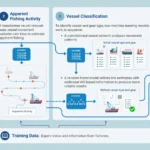
Global Fishing Watch analysts examined Panamanian vessel monitoring system data for the 14 suspicious vessels, expanding the analysis time window to capture full behavioral patterns for their entire journey. This approach helped distinguish normal navigation from apparent fishing maneuvers inside the areas where longline fishing is prohibited.
In several cases, the analysis identified not only apparent fishing activity, but also navigation at speeds below six knots and an irregular course within the MPA — actions also prohibited under Panamanian law. These findings strengthened the legal robustness of the authorities’ case.
Beyond delivering technical reports, Global Fishing Watch also worked closely with the ARAP and MiAmbiente teams to support the use of vessel-tracking evidence in administrative procedures. Internal reports from Panama’s Fisheries Monitoring Center were refined, incorporating more detailed behavioral assessments and cross-checking data with landing declarations and logbooks, when available.
This process relied on close coordination across institutions. Environmental authorities, fisheries inspectors, legal teams and security forces worked together, supported by satellite vessel tracking data that provided a shared, objective picture of what was happening at sea.
The outcome was tangible. Administrative resolutions issued throughout 2025 by ARAP imposed fines on multiple vessels, along with penalties for captains and temporary license suspensions. Several cases are still progressing through appeal processes, but the message to the Panamanian fishing fleet was unmistakable: now, the authorities have sharp eyes on the ocean.
A year ago, satellite data revealed illegal fishing activity inside Panama’s Coiba Ridge MPA. But today, that same data tells a different story.
But this is not just a story about sanctions. More importantly, it is a story about deterrence. The Coiba Ridge case not only demonstrates how vessel tracking can support effective MPA management but it also highlights the value of integrating data, local expertise and institutional coordination into monitoring, control and surveillance (MCS) systems.
For Global Fishing Watch, the collaboration marked an important milestone bringing together analytical, legal and country-level expertise to support real-world outcomes. For Panama, it strengthened the country’s ability to protect one of its most ecologically significant marine areas, enabling it to continue providing benefits to local and regional communities. And for the ocean, the end result is especially clear: a vital marine protected area is now respected.
As Panama prepares to host the upcoming South Pacific Regional Fisheries Management Organization (SPRFMO) meeting, the Coiba Ridge case offers a timely and concrete example of how transparency and enforcement can contribute to the conservation of marine ecosystems. Delegates gathering to discuss MCS, compliance matters, and illegal, unreported and unregulated (IUU) fishing will do so against the backdrop of a regional success story that shows what is possible when vessel tracking data is effectively integrated into decision-making and enforcement processes.
The experience in Coiba Ridge underscores a key takeaway for SPRFMO members: monitoring alone is not enough. Real behavioral change begins when data is accessible, shared and paired with institutional coordination and legal follow-through.
We use cookies to keep our site running smoothly and to understand how you interact with us. Allowing cookies helps us give you the best, personalized experience. If you opt out, some parts of the site might not work as beautifully as they should.
Take a quick website survey to help us build a better experience for visitors like you.