Vessel tracking and Indigenous stewardship are strengthening Rapa Nui’s marine protection efforts
Key takeaways
- Marine Manager integrates AIS and VMS data to provide near real-time maritime transparency, empowering remote communities to detect illegal industrial fishing.
- Indigenous stewardship combines ancestral knowledge with cutting-edge technology to co-manage the 270,000-square-mile Rapa Nui MPA, ensuring long-term ecological sustainability.
- Strict industrial fishing bans preserve critical coral ecosystems and yellowfin tuna breeding grounds, safeguarding the artisanal livelihoods of Rapa Nui.
A new partnership between Global Fishing Watch and Rapa Nui is delivering cutting-edge technology to one of the most remote communities in the world in an effort to help preserve the island’s vast marine protected area (MPA).
Set in the heart of the Pacific Ocean, more than 1,900 miles (3,200 kilometers) from the Chilean mainland, Rapa Nui — also known as Easter Island — is now deploying Global Fishing Watch Marine Manager, an innovative technology portal co-founded by Dona Bertarelli, to track industrial fishing activity in and around its MPA.
“We transform millions of daily data points into clear, actionable insights,” said Mónica Espinoza Miralles, head of Global Fishing Watch’s Latin America program. “Our focus is now on the frontline, applying this technology within marine protected areas to empower local managers and ensure the long-term health of our ocean.”
The Rapa Nui MPA was established in 2018 following an Indigenous consultation process led by the community itself and spans 270,000 square miles (700,000 square kilometers) of ocean — an area larger than many countries. Before its creation, up to 83 industrial fishing vessels operated in the surrounding waters, encroaching on ancestral fishing grounds and fragile marine ecosystems. That number has since dropped, according to data from the Koro Nui o te Vaikava, or Council of the Sea, the local authority that co-manages the ocean space with the Chilean state. Still, daily management of the island’s waters remains a resource-intensive effort.
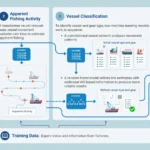
Now, by integrating automatic identification system and vessel monitoring system data, Marine Manager has become a key tool in implementing the Rapa Nui management plan. The portal enables authorities to monitor industrial fishing fleets near the boundaries of the protected area, identify patterns in fishing and maritime traffic, strengthen compliance and support science-based decision-making, while also building technical capacity among local stakeholders.
“Marine Manager is a tool that enables users to view activity at sea based on data from vessels,” noted Carlos Chacón, senior manager for Latin America at Global Fishing Watch. “That data lets our systems analyze what is happening on the water — whether vessels are fishing, transiting or engaged in other maritime activity. With that information, protected-area managers can monitor what is happening and make decisions.”
Fishing within the Rapa Nui marine protected area is strictly artisanal. A ban on industrial fishing aims to preserve both ecological balance and the livelihoods of local communities, which focus on catching high-value species such as yellowfin tuna, swordfish and marlin. The area also protects more than 140 species and serves as a critical breeding ground for large pelagic fish as well as a habitat for coral reef ecosystems.
According to Sebastián Yancovic Pakarati, a councilor with the Koro Nui o te Vaikava, the partnership with Global Fishing Watch offers a prime example of how ancient tradition and technological transparency can combine to ensure a sustainable ocean future.
“The ocean shapes us,” Pakarati said. “It leads us and guides us toward the development we need — something we have sustained for the past thousand years and want to carry forward for another thousand.”