ⓒ Ben Dilley
The Issue
Marine protected areas (MPAs) are only as effective as authorities’ ability to enforce them. In Africa, where illegal, unreported and unregulated (IUU) fishing accounts for an estimated 40 percent of total catch, addressing IUU activity by industrial fleets remains a persistent challenge. Without effective vessel monitoring and enforcement, even well-designed MPAs can remain vulnerable to illegal activity.
Gabon’s Grand Sud Reserve, one of the largest MPAs in West and Central Africa, safeguards vital continental shelf ecosystems and is home to one of the world’s most important nesting beaches for leatherback sea turtles. With more than 26 percent of its waters under protection, Gabon has made ocean conservation a national priority. But policing such a vast maritime region stretches enforcement resources and exposes the area to industrial bottom trawlers that are otherwise prohibited from operating inside the reserve.
Our Work
Since 2016, Operation Albacore — a partnership between the Gabonese government and Sea Shepherd — has supported efforts to combat illegal fishing in Gabonese waters. To support this decade-long initiative, Global Fishing Watch partnered with the operation and contributed satellite-derived vessel intelligence, technology and training to help authorities plan and carry out targeted patrols.
In preparation for a patrol conducted in July 2026, Global Fishing Watch delivered a patrol planning workshop in the Gabonese capital, Libreville, for 25 personnel from Gabon’s Directorate General for Fisheries and Aquaculture, its National Agency of National Parks and the Gabonese Navy. The training combined intelligence analysis with operational planning to help enforcement teams use vessel tracking data during patrols.
As part of the collaboration, Global Fishing Watch also produced a tailored intelligence report identifying high-risk areas and vessels of interest. Rather than conducting broad patrols across Gabon’s vast waters, authorities and Sea Shepherd used Global Fishing Watch’s analysis to focus their efforts on a fleet of five industrial trawlers operating about 10 kilometers inside Gabonese waters. Knowing exactly where to look, Sea Shepherd’s patrol vessel, the Age of Union, and Gabonese law enforcement quickly mobilized.
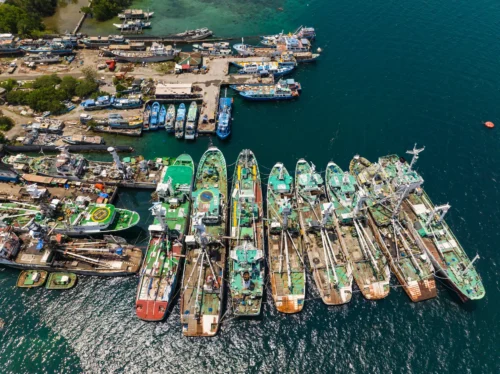
On July 18, 2026, the patrol intercepted three trawlers, identified by authorities as the Rong Chang 19, Rong Chang 26 and Chang Hiu 01. The vessels were boarded and found to be operating without valid fishing licenses or documentation. One vessel was intercepted while attempting to discard its trawl net, apparently in an effort to destroy evidence. All three were escorted 200 kilometers north to Libreville for detention, while authorities rescued bycatch, such as octopuses, catsharks and angelsharks, from the trawlers’ nets.
The seizure of the Rong Chang 19, Rong Chang 26 and Chang Hiu 01 is the most recent enforcement success for Gabonese authorities working under the aegis of Operation Albacore. Over the past decade, Operation Albacore has indeed led to the seizure of 16 vessels for illegal fishing in Gabonese waters. However, the latest patrol confirms the operational value of integrating Global Fishing Watch tools into enforcement efforts as satellite intelligence, targeted patrol planning and coordinated enforcement can support governments to strengthen compliance within their waters and improve protection of marine ecosystems.
The vessel owner of the three detained trawlers has since reached a settlement with Gabonese authorities.