fishing

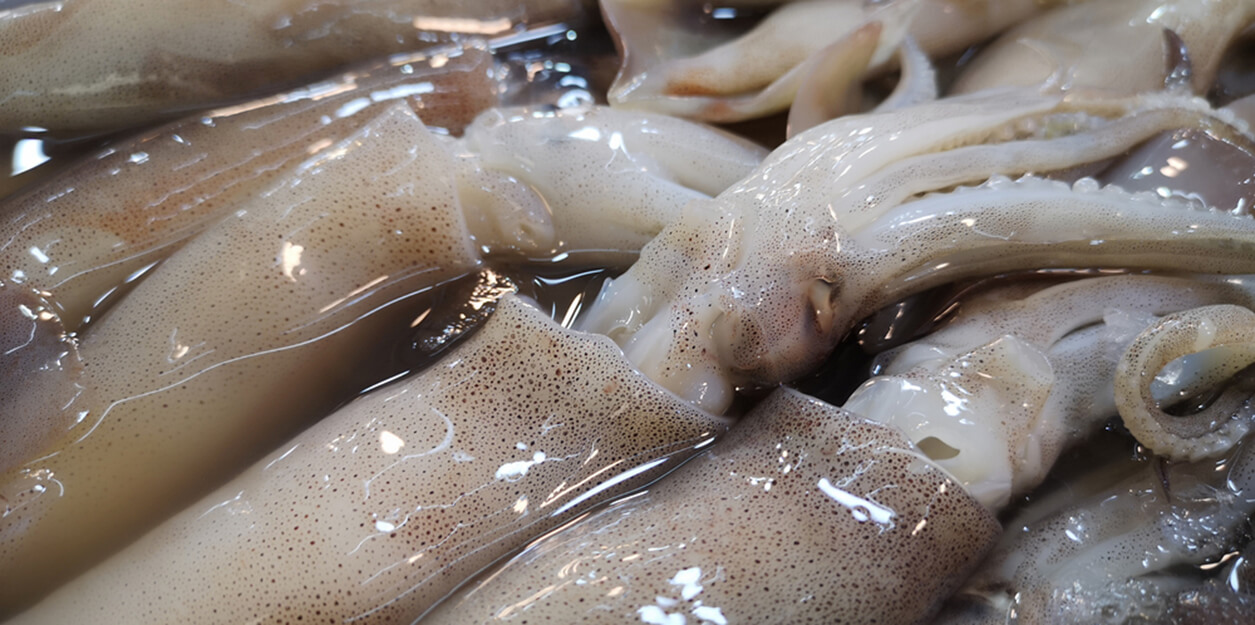
Where is your squid coming from? Most likely unregulated waters, according to a new international study

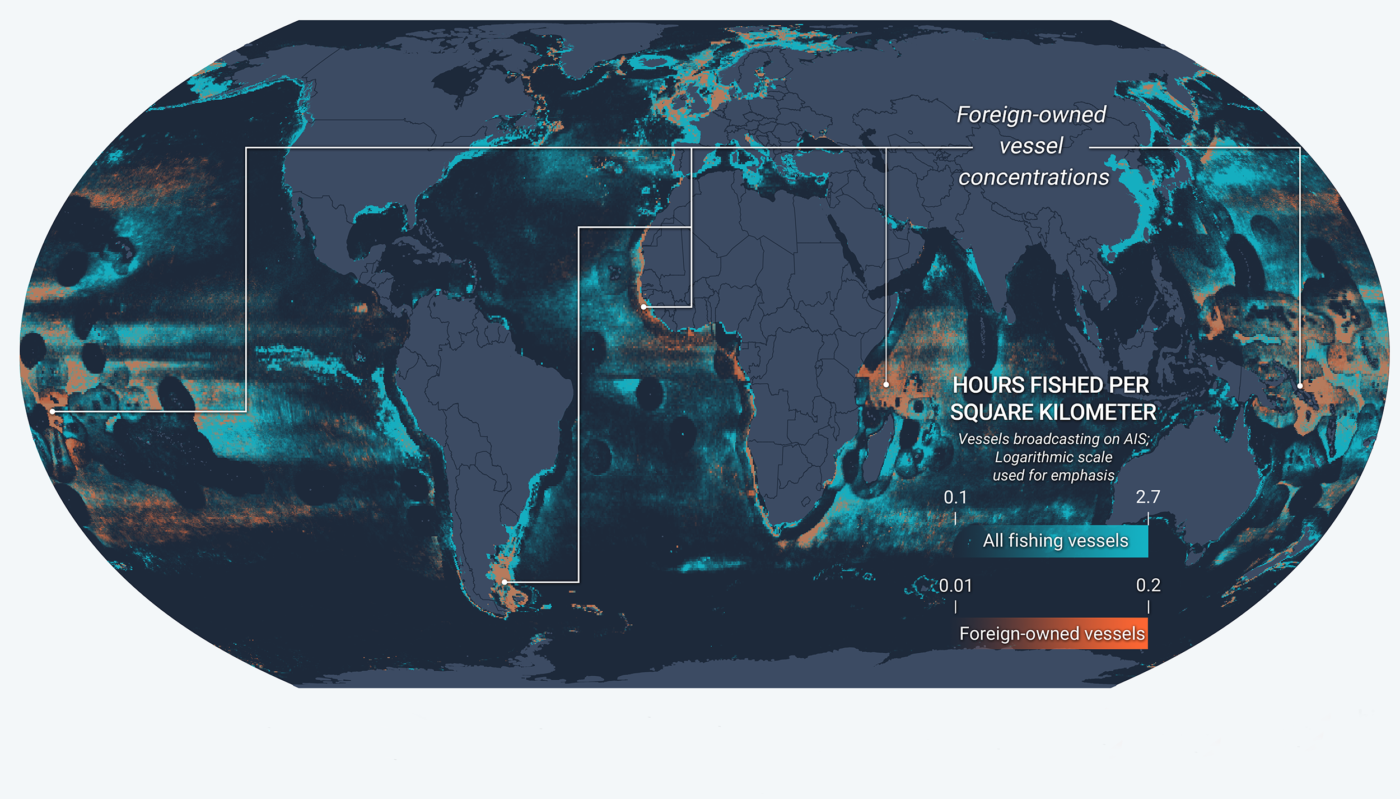
New research fuses multiple data sources to advance understanding of the expanding footprint of global squid fleets Scientists and policymakers have voiced growing concerns about the decline of global squid stocks, but little has been done to date to target squid fishing activities that are expanding into unregulated spaces, according to a new international study.
Where is your squid coming from? Most likely unregulated waters, according to a new international study Read More »

New Fusion of Global Datasets Advances Understanding of Vessel Identity and Activity

Novel research provides new tool to improve global fisheries oversight Illegal, unreported and unregulated (IUU) fishing accounts for up to $23.5 billion every year and is enabled by vessels frequently changing their name, flag State or owner. New research , led by Global Fishing Watch and published in Science Advances , uses big data processing and a compilation of global datasets to track

New Fusion of Global Datasets Advances Understanding of Vessel Identity and Activity Read More »

New research reveals shifting identities of global fishing fleet to help bolster fisheries management

Scientific study fuses multiple data sources to advance global understanding of vessel identity and behavior A new study published today in Science Advances combines a decade’s worth of satellite vessel tracking data with identification information from more than 40 public registries to determine where and when vessels responsible for most of the world’s industrial fishing

New research reveals shifting identities of global fishing fleet to help bolster fisheries management Read More »

Marine Manager Enhances Coastal Conservation Efforts

Monitoring portal helps Guyana track increased vessel traffic from growing oil and gas industry Shell Beach is Guyana’s only coastal protected area and a renowned sea turtle nesting area. © Reel Guyana When a major global energy company discovered oil and gas reserves off the coast of Guyana in 2015, the nonprofit group Guyana Marine Conservation

Marine Manager Enhances Coastal Conservation Efforts Read More »

World’s Most Remote Island Community Safeguards Waters With Help From Marine Manager

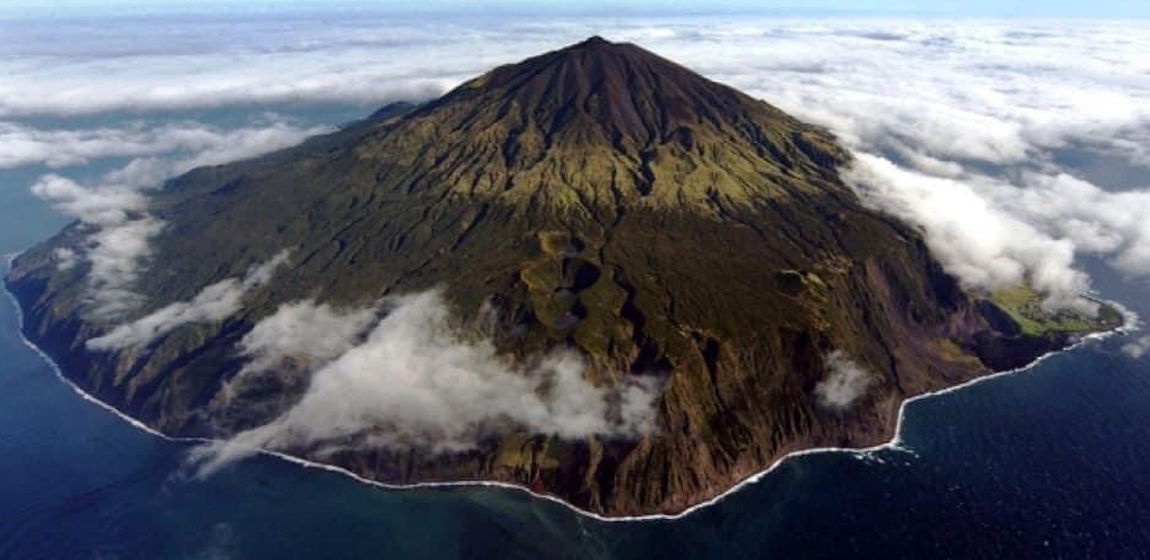
Technology portal synthesizes data to protect Tristan da Cunha’s biodiversity Tristan da Cunha, part of a volcanic archipelago in the South Atlantic Ocean, is surrounded by rich marine biodiversity. © Andy Schofield / Royal Society for the Protection of Birds It is hard to get more remote than Tristan da Cunha. The eponymous main island

World’s Most Remote Island Community Safeguards Waters With Help From Marine Manager Read More »

fish underwater

With New Global Accessibility and Data Features, Marine Manager Raises the Bar on Ocean Monitoring

Latest release of online tool will help more people monitor and manage greater expanses of the seas A screenshot taken from the portal shows the overlay of different datasets: sea surface temperature and salinity, along with fishing activity. © Global Fishing Watch In our brief but exciting history working to shed greater visibility on what’s

With New Global Accessibility and Data Features, Marine Manager Raises the Bar on Ocean Monitoring Read More »

A sea turtle swims underwater over a rocky, sunlit ocean floor as rays of sunlight filter through the clear water from above.

Technology and Innovation for Marine Protected Areas Management

The ocean covers nearly 70 percent of the planet–14 million square kilometers–providing a huge challenge for monitoring activity and enforcing regulations across its vast expanse. That activity includes illegal, unreported and unregulated (IUU) fishing, which accounts for up to $23 billion worth of seafood every year, or one in every five wild-caught fish.

Technology and Innovation for Marine Protected Areas Management Read More »

AIS disabling hotspots map

Hotspots of Unseen Fishing Vessels Illuminate Areas of Concern for Illegal, Unreported and Unregulated Fishing

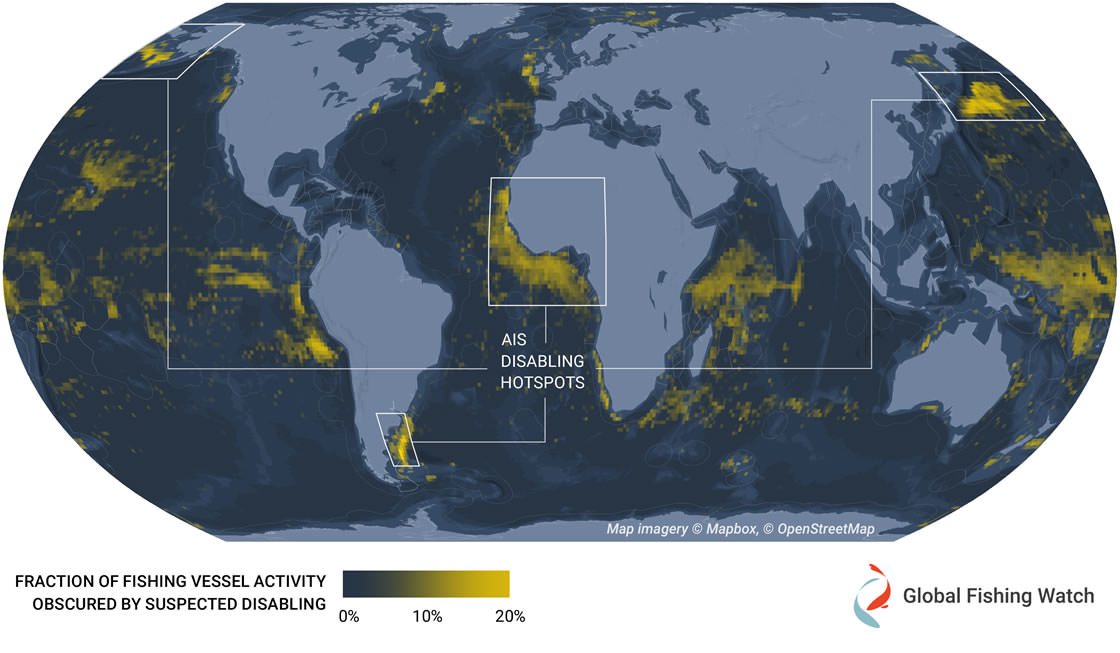
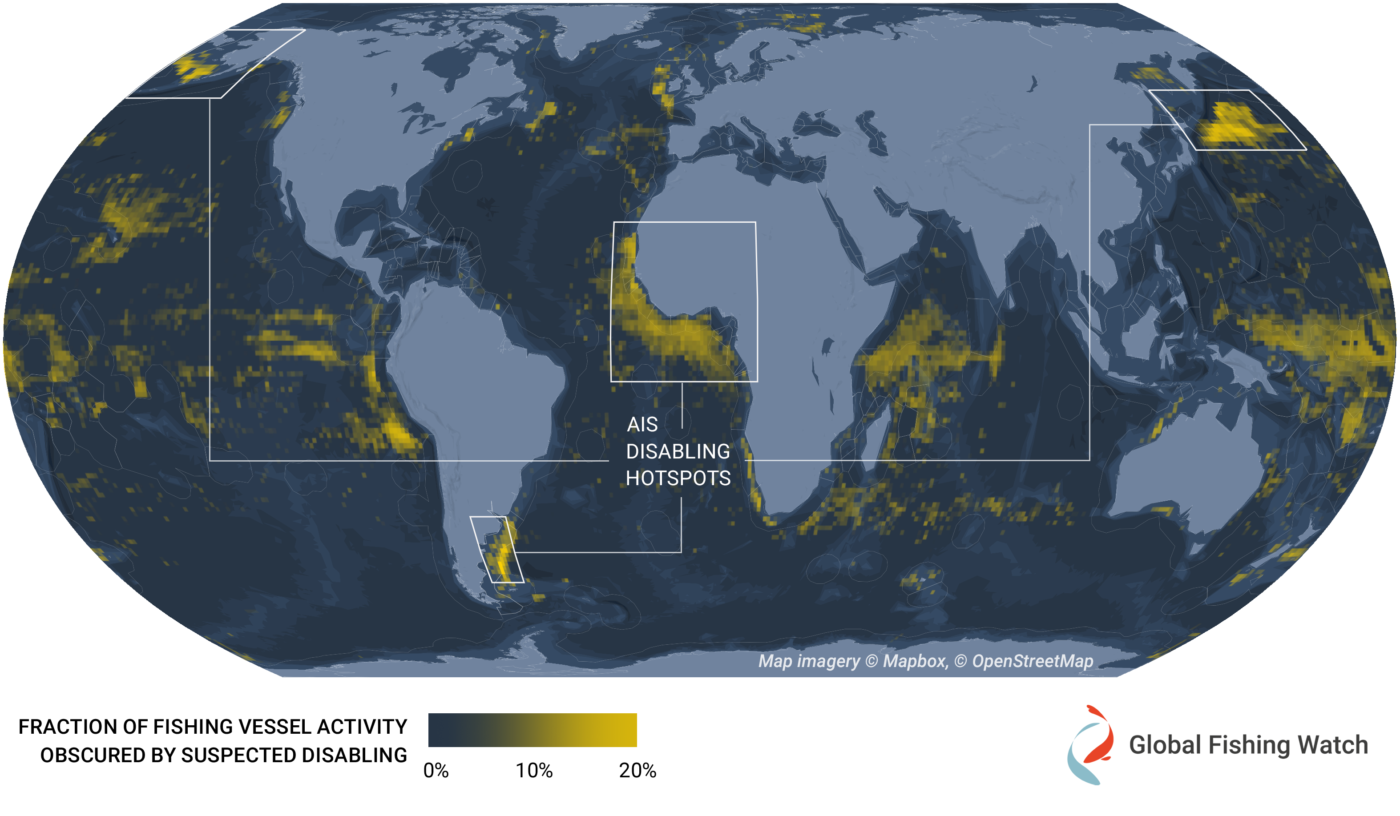
New study provides first global dataset examining intentional disabling of automatic identification system devices across commercial fisheries The ocean is vast and ship crews rely on several tools to navigate it safely. One of these tools is the automatic identification system, commonly referred to as AIS, which uses GPS transponders to regularly broadcast critical information,

Hotspots of Unseen Fishing Vessels Illuminate Areas of Concern for Illegal, Unreported and Unregulated Fishing Read More »

Global analysis shows where fishing vessels’ identification devices have been switched off

New research displays intentional disabling of automatic identification system devices to provide insights into illegal, unreported and unregulated fishing activity A new analysis harnesses automatic identification system, or AIS, data to provide information about global fishing activity, including illegal, unreported and unregulated fishing. Originally designed as a collision avoidance tool, AIS can be intentionally disabled—sometimes

Global analysis shows where fishing vessels’ identification devices have been switched off Read More »

New Data Reveals Bottom Trawling In Protected Areas

Greater transparency needed to stop illegal fishing in the Mediterranean Members of the Med Sea Alliance, a diverse coalition of nonprofit organizations, today launched a new data atlas which, for the first-time, maps areas permanently closed to bottom trawling across the Mediterranean and investigates illegal trawling in these areas. The Atlas is an online tool

New Data Reveals Bottom Trawling In Protected Areas Read More »

Global Fishing Watch welcomes partnership with Papua New Guinea to share vessel tracking data

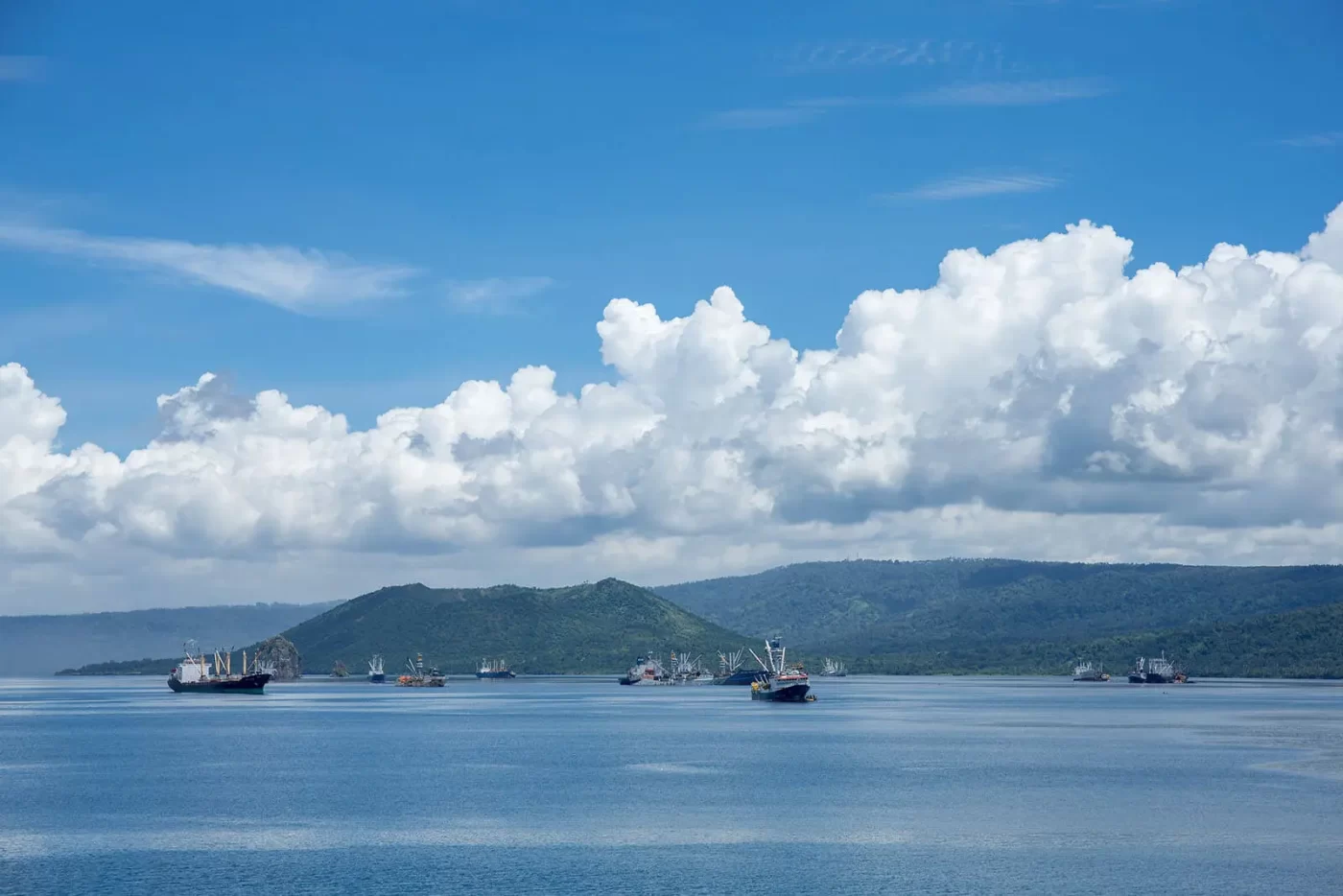
Momentum builds as a second nation in the Pacific makes critical decision to make fishing activity data accessible and transparent  In a newly established partnership with Global Fishing Watch, Papua New Guinea has committed to sharing vessel tracking data from its Fishing Industry Association on the organization’s public map. Through this agreement, the Pacific island

Global Fishing Watch welcomes partnership with Papua New Guinea to share vessel tracking data Read More »

Global Fishing Watch staff behind FAO sign

Transparency Can Bring Forward Outcomes of International Fisheries Meeting

Committee on fisheries advances transshipment monitoring, vessel identification and tracking to fight illegal fishing © Shutterstock International fisheries are managed through a patchwork of regulations, which present loopholes that are often exploited for financial gain, undermining collective good governance efforts. To help address this, every two years, the Committee on Fisheries (COFI) of the Food

Transparency Can Bring Forward Outcomes of International Fisheries Meeting Read More »

people in room

In Latin America, Training Helps Governments to Discover Suspicious Behavior

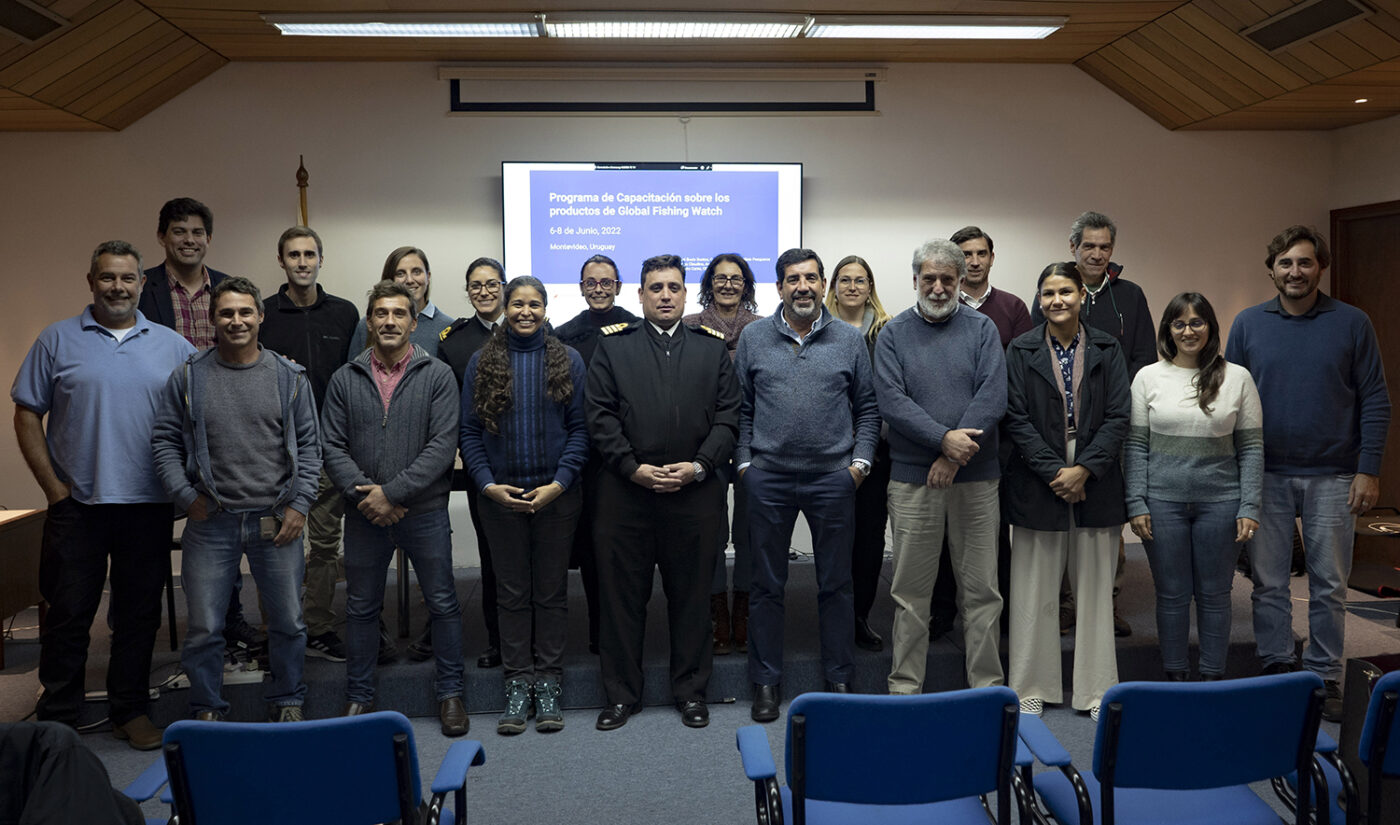
Global Fishing Watch reinstates in-person training with partners to strengthen the use of technology in support of responsible ocean management Lack of available information on global and regional fishing activity is one of the biggest challenges when it comes to monitoring the ocean and understanding the true extent of humanity’s impact on the sea.  To

In Latin America, Training Helps Governments to Discover Suspicious Behavior Read More »

Peruvian boobies

Seabirds: An Unexpected Ally in Fisheries Monitoring

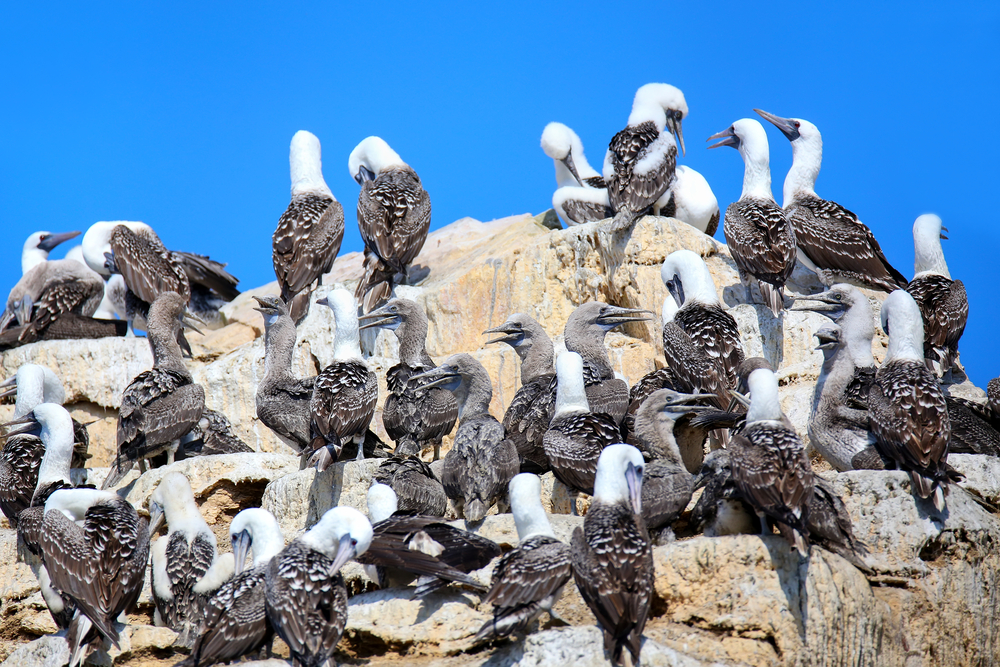
An innovative research project allows scientists to see through the eyes of seabirds to understand interactions with the Peruvian anchovy fishing fleet https://youtu.be/rI0Yj8aYhOE On any given day, you can find a wreck of seabirds soaring above the waters of Peru’s largest fishery—the anchovy—swooping down toward various fishing vessels hauling in their catch. These sentinels of

Seabirds: An Unexpected Ally in Fisheries Monitoring Read More »

cogs over water

Free and open data to inspire next wave of ocean solutions

Global Fishing Watch establishes new portal to make application programming interfaces available to public Inequitable access to data and technology in support of ocean stewardship often leads to lost opportunities in decision-making and innovation—especially in under-resourced countries.  The international community continues to fall short in its efforts to conserve and sustainably use the ocean and

Free and open data to inspire next wave of ocean solutions Read More »

Scroll to Top

Help us improve the site

Take a quick website survey to help us build a better experience for visitors like you.