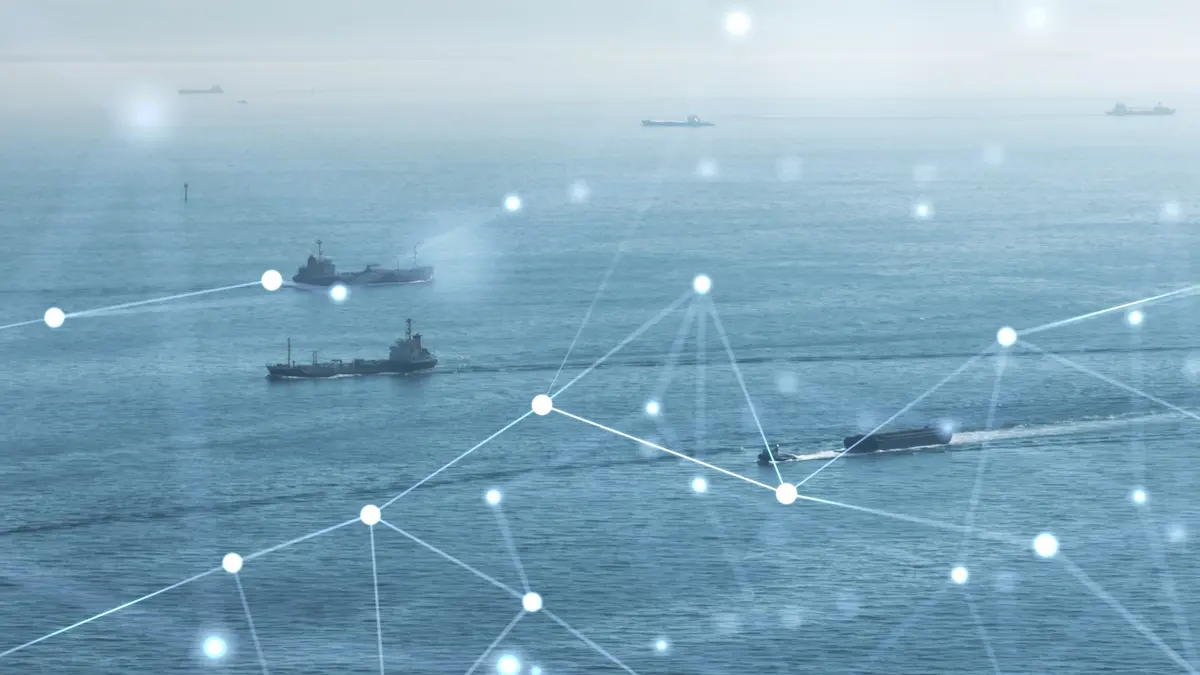
IUU Fishing Risk Insights Dataset Release
Global Fishing Watch has released new research into what constitutes a behavior risk indicator of illegal, unreported and unregulated (IUU) fishing. Available exclusively in our data download portal, this update offers a structured, data-driven and evidence-based approach to assessing vessel risk.
Compiled and developed through a rigorous literature review and expert consultation, these insights are based on critical behavioral characteristics, including:
- Who a vessel interacts with at sea.
- How it stays hidden without broadcasting positional data.
- How transparently it broadcasts its identity.
Building on the data layers currently available across the Global Fishing Watch map and APIs, these newly released insights further enable users to understand specific behavioral patterns that may indicate a higher likelihood of IUU fishing activity.
What’s included in this release?
The full dataset features 11 risk indicators. Four insights are already available visually on the Global Fishing Watch map — total number of encounters, number of AIS disabling events over 12 and 24 hours, and IUU vessel listings. The others are brand-new behavior risk insights available for download.
IUU fishing risk indicators
Indicator 1
Total at-sea encounters: The frequency of close-proximity events with other vessels, signaling potential transshipment.
Indicator 2
Encounters with IUU-listed vessels: Interactions with vessels currently blacklisted by regional fisheries management organizations (RFMOs).
Indicator 3
Encounters with previously IUU-listed vessels: Interactions with vessels previously listed in RFMOs’ IUU vessel lists.
Indicator 4
Encounters with vessels reported for forced labor: Interactions with vessels linked to documented labor abuses.
Indicator 5
Network proximity to IUU-listed vessels: The degrees of separation between a vessel and known offenders within an encounter network.
Indicator 6
Network proximity to vessels reported for forced labor: The degrees of separation from vessels associated with labor abuses.
Indicator 7
Average voyage duration: The average length of time a vessel remains at sea.
Indicator 8
Number of voyages: The total number of voyages.
Indicator 9
Suspected AIS disabling: Unexplained tracking gaps indicative of intentional shutdown. This measures total events exceeding 12 hours and 24 hours.
Indicator 10
Unexplained AIS gaps: Any loss of transmission longer than six hours, regardless of location or reception quality.
Indicator 11
Suspected identity spoofing: The total time a vessel broadcasts the same identity or maritime mobile service identity (MMSI) number simultaneously with another vessel.
Key differences between the dataset and the map
The new IUU Fishing Risk Insights use a proof of concept dataset to train an updated secondary classifier model that better estimates vessel type. Because this model is currently localized to this release, the risk insights for a specific vessel may differ between what you download in the data download portal and what you see on the public Global Fishing Watch map and APIs.
- Timeline for alignment: The new secondary classifier dataset is scheduled to be integrated into the Global Fishing Watch map in October 2026. Once live, results will fully align across all tools.
These insights will provide credible, actionable inputs for practitioners, authorities and researchers working to combat IUU fishing, particularly those responsible for monitoring and assessing vessel and fleet-level risks.
Here is the full list of data fields used to create the dataset.
| Indicator | Field | Description |
|---|---|---|
| Total at-sea encounters | number_encounters | The number of events where AIS data shows two vessels that appear to be meeting at sea in that year. |
| Encounters with IUU-listed vessels | number_iuu_listed_encounters | The number of encounters with vessels listed on an RFMO list as an IUU offender in that year. |
| Encounters with previously IUU-listed vessels | number_previously_iuu_listed_encounters | The number of encounters with vessels listed on an RFMO list as an IUU offender in a previous year, but not in the year that the encounter took place. |
| Encounters with vessels reported for forced labor | number_forced_labor_encounters | The number of encounters with reported forced labor vessels. |
| Network proximity to IUU-listed vessels | dist_to_iuu | The shortest ‘distance’ based on encounters from that vessel to a reported RFMO-listed IUU offender in that year. |
| Network proximity to vessels reported for forced labor: | dist_to_forced_labor | The shortest ‘distance’ based on encounters from that vessel to a vessel that we have listed as a reported forced labor offender in that year. |
| Average voyage duration | average_voyage_duration | The average duration between detected port visits (in hours) in that year. |
| Number of voyages | number_voyages | A “voyage” is defined as the combination of a vessel’s previous port visit’s end and next port visit’s start. The number of voyages is for that year. |
| Suspected AIS disabling | disabling_over_12_hours | The number of AIS gaps that are suspected to be AIS disabling in the given year. Calculated between 2017-2025. |
disabling_over_24_hours | The number of AIS gaps longer than 24 hours that are suspected to be AIS disabling. Calculated between 2017-2025. | |
| Unexplained AIS gaps | gaps_count | The number of AIS gaps detected (that do not meet the criteria for likely disabling intentional disabling). Calculated between 2017-2025. |
| Suspected identity spoofing | overlap_hours_multinames | The total number of hours of overlap between two segments where, over the time period of the two segments that overlap, the vessel broadcast two or more normalized names, where each normalized name was broadcast at least 10 or more times. |
Vessel IUU Fishing History
| Field | Description |
|---|---|
iuu_listed | The vessel is on an RFMO IUU list in that year. |
previously_iuu_listed | The vessel was on an RFMO IUU list in a previous year, but is no longer listed. |
Important note: To ensure accurate analysis, we strongly encourage you to review the specific caveats and methodology notes associated with this release.
Full documentation is available on the data download portal.
If you need further clarification, please reach out to our team at [email protected].