
© Hussain Naushad
Shedding light on ownership structures can foster a more accountable and responsible fishing sector
Key takeaways
- Mandating ultimate beneficial ownership (UBO) transparency empowers authorities to identify hidden financial beneficiaries driving illegal, unreported, and unregulated (IUU) fishing.
- Policymakers must require UBO data for vessel registration and licenses to prevent state subsidies from financing illicit maritime operations globally.
- Integrating interoperable UBO registries with tracking tools like Vessel Viewer disrupts flag-hopping, enabling RFMOs to enforce cross-jurisdictional maritime accountability effectively.
Overview
The commercial fishing industry is a critical pillar of the global economy and international food security, yet it operates in one of the most opaque regulatory environments. While modern technology allows authorities to track vessel movements across the high seas and territorial waters, tracking the actual financial beneficiaries of these vessels remains a challenge. Illegal, unreported, and unregulated (IUU) fishing depletes marine ecosystems, exploits vulnerable workers and robs coastal nations of billions in economic revenue. And for too long, the true architects of these illicit activities have evaded accountability by hiding behind a veil of corporate secrecy.
Downloads
Related Expert

Director of International Policy, Global Programs
Recent Content
To meaningfully protect our ocean and ensure a fair, sustainable maritime economy, enforcement cannot stop at the water’s edge. Focus must be widened from vessels on the ocean to individuals behind companies. Doing so requires adopting and enforcing transparency standards around a concept known as ultimate beneficial ownership, or UBO.
Global Fishing Watch’s mission is built on the conviction that transparency is the most powerful tool to achieve ocean sustainability — that is, the act of making specific ocean and vessel data, as well as the policies and decisions that surround them, available to those that need them. By championing transparency at the international level, we aim to shape policies and empower the global community to strip away the anonymity that often shields ocean exploitation.
Ultimate beneficial ownership data is a critical piece of the puzzle, linking fishing operations to individuals responsible for a vessel’s activities. Currently, gaps in ownership data create a dangerous veil for illicit actors. Those profiting from illegal activities — at the expense of seafood sustainability and biodiversity — cannot be held accountable if the true beneficiaries remain hidden. For regulations to be effective, authorities must have the clarity required to deliver meaningful sanctions. Without knowing who truly profits from fishing, the path to justice is obstructed and the ocean remains vulnerable to exploitation.
What is ultimate beneficial ownership?
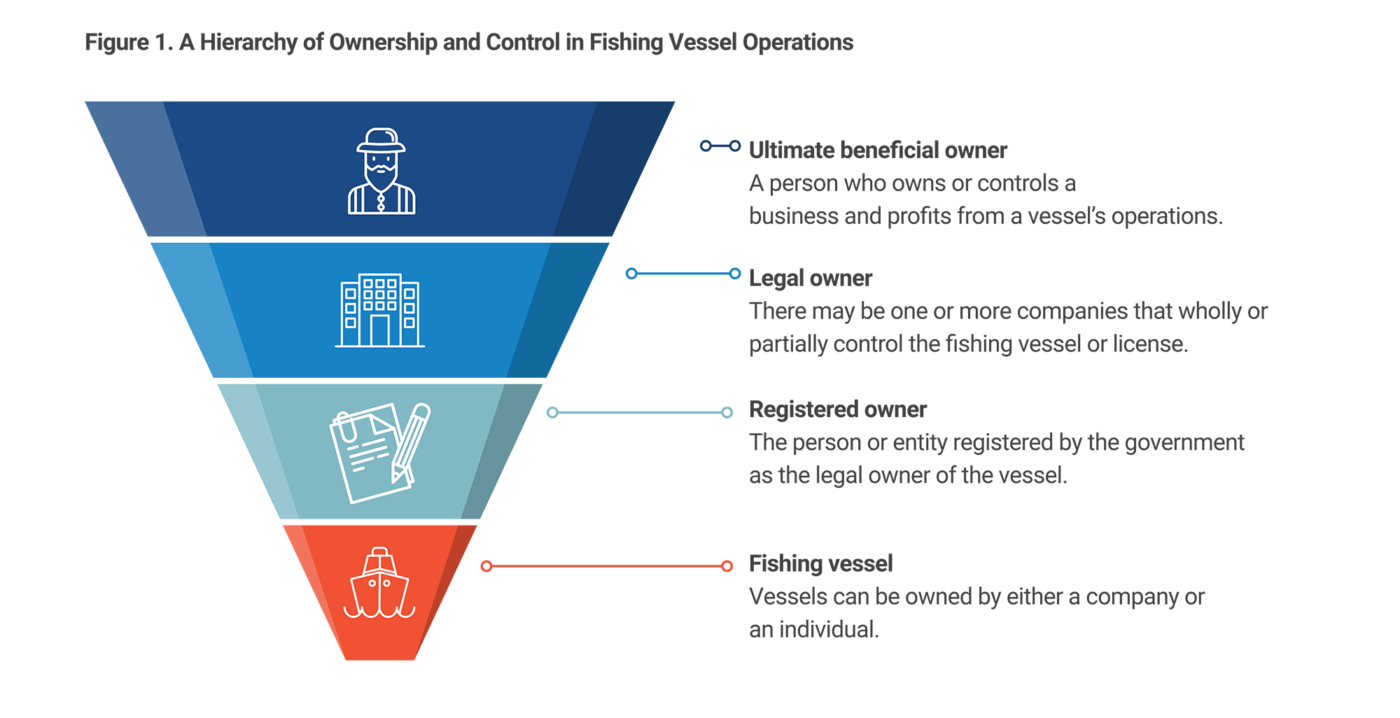
Ultimate beneficial ownership refers to the natural person who ultimately owns or controls a company, asset or fishing license. In the commercial fishing industry, a vessel is typically registered to a single corporate owner on paper — this is often referred to as the registered owner or legal owner. However, that company may itself be owned by one or more other companies, all of which could be incorporated in different jurisdictions. Only by identifying the individuals behind all these parent companies can we know who truly controls and profits from a vessel’s activities.
Figure 1. A Hierarchy of Ownership and Control in Fishing Vessel Operations
Why UBO matters in fisheries governance
Identifying the true beneficiaries of global fisheries is a fundamental cornerstone of accountability and sustainable ocean management. Mandating UBO transparency strengthens fisheries governance by equipping authorities with a more comprehensive picture of who actually controls and profits from marine resources. By shedding light on these hidden ownership structures, governments are better positioned to take decisive action to:
Prevent illicit activities: Beneficial ownership transparency is vital for preventing illicit activities in the fisheries sector as well as other transnational crimes, such as labor abuse or the trafficking of drugs, arms or even people. It provides clarity on exactly who holds licenses and operates fishing vessels to ensure the effective management of access to exclusive economic zones (EEZs) and allows authorities to penalize unscrupulous operators.
Protect seafood supply chains: Transparency contributes directly to maintaining seafood supply chain integrity. It enables governments to detect and prevent illicit products from entering the market, ensuring that consumers and retailers can trust their seafood is legally and responsibly sourced.
The global context
Although there is currently no universally binding international requirement for the disclosure of beneficial ownership information in the fisheries sector, transparency initiatives and international fora have increasingly recognized its importance.
Recognition of beneficial ownership challenges in fisheries
At its 36th Session in 2024, the UN Food and Agriculture Organization’s (FAO) Committee on Fisheries formally “recognized the importance and challenges of identifying beneficial ownership of fishing vessels” and encouraged Members States and sub-committees to further consider the issue. In parallel, organizations such as the Financial Action Task Force, the Extractive Industries Transparency Initiative and Open Ownership continue to promote beneficial ownership transparency as an emerging global best practice.
The United Nations' call for accountability
In 2021, UN Member States acknowledged the critical role of transparency in beneficial ownership toward combating corruption and illicit financial flows. While the resulting General Assembly resolution, “Our Common Commitment to Effectively Addressing Challenges and Implementing Measures to Prevent and Combat Corruption,” sparked significant transparency advancements in extractive industries like oil and mining, the global fisheries sector continues to lag dangerously behind. Today, authorities striving for sustainable ocean governance still grapple with deliberately opaque ownership structures. This corporate secrecy effectively prevents them from identifying the true financial beneficiaries of fisheries operations, making it incredibly difficult to hold bad actors accountable for IUU fishing.
Directives to sever illicit financial support
Recognizing this critical gap in maritime accountability, the Organization for Economic Cooperation and Development (OECD) took decisive action in April 2025. During its ministerial-level council meeting, the OECD formally adopted a landmark recommendation aimed at eliminating government support for IUU fishing. Crucially, this mandate urges member nations to implement rigorous policies that require the collection and leveraging of UBO data for vessel authorizations and IUU fishing determinations. By officially tying beneficial ownership transparency to State subsidies, the OECD created a powerful framework to ensure that public funding does not inadvertently finance illicit fleets.

Challenges in UBO transparency
Currently, the collection of UBO information in the fisheries sector remains heavily inconsistent. This vital data remains hidden due to regulatory gaps, cultural and institutional resistance, operational and financial constraints, as well as data privacy concerns and a lack of technical capacity within fisheries authorities.
Furthermore, the deliberate use of complex ownership structures and practices — such as flag-hopping and vessel renaming — complicates the identification of ultimate beneficial owners. These tactics create layers of obscurity, making it difficult for authorities to trace and hold accountable those behind illicit fishing activities, ultimately undermining efforts to enforce regulations and combat IUU fishing.
The cost of inaction
Without accurate UBO information, flag and coastal States can only take action against the operators and crew they can physically access or identify when vessels come into port. This dynamic unjustly penalizes individuals — those who are often working intensively for very little benefit — rather than addressing the root of the problem. As a result, crew members are simply replaced while the true beneficiaries continue to profit in the shadows, perpetuating the cycle of abuse.
To effectively manage and protect our ocean resources, we must close the loopholes that allow bad actors to hide behind complex ownership structures and flags of convenience. It is essential for flag and coastal States to collect and disclose UBO information to exercise effective control over the fishing activities they govern, and to finally hold accountable the people actually profiting from unscrupulous practices.
Key recommendations: A roadmap for accountability
Achieving meaningful transparency in the global fishing sector requires more than acknowledging the problem — it demands decisive, coordinated action from governments, regulatory bodies and the international community. To dismantle the opaque corporate structures that enable illegal fishing and exploit marine ecosystems, States must move beyond theoretical commitments and adopt a comprehensive approach that integrates legal reform with modern data standards and technological innovation.
Global Fishing Watch urges policymakers to take the following actions to operationalize UBO transparency and ensure the true beneficiaries of ocean extraction are held accountable.
Strengthen policy: Require the collection of UBO data as a condition for vessel registration and licensing, while ensuring confidentiality rules are not misused to shield unscrupulous operators. Ensure data is robust enough for automated systems and vessel-level analyses.
Mandate transparency and interoperability of UBO data: Make UBO data publicly available through national, regional and global databases, including FAO’s Global Record and ensure interoperability between databases.
Enhance international cooperation: Build capacity through international cooperation and knowledge sharing. Promote UBO transparency through international forums and build capacity for UBO data use with support from regional fisheries bodies and the FAO.
Improving access to reliable UBO information
Collecting comprehensive and reliable beneficial ownership information is essential for enhancing transparency, regulatory oversight and enforcement against illicit activities such as IUU fishing.
Verifying ownership information remains a significant challenge across jurisdictions. As countries seek to strengthen transparency, there is growing demand for practical guidance on effective verification approaches. Current best practices include cross-checking vessel ownership records against company registries, corporate filings, tax records and other government databases to identify inconsistencies or concealed ownership structures. Looking ahead, there is also increasing potential for digital systems to integrate vessel activity data with ownership information, enabling more holistic monitoring, risk assessment and fisheries management.
The interoperability mandate: Why data sharing is essential
Transparent ownership structures can drive a profound shift toward greater accountability and sustainability in the fisheries sector. Instead of relying on a labyrinth of confusing paper trails that easily fall between the cracks in jurisdictions, authorities need an interconnected set of data registries. When these digital systems communicate with one another, they can automatically inform governments when errors, discrepancies or missing information should be investigated. If this data is publicly available, ownership complexities can be resolved and flag-hopping chains can be easily followed, leaving no room for confusion as to who has appropriate jurisdiction over a vessel.
Tools and data: How Global Fishing Watch supports UBO

Global Fishing Watch integrates UBO requirements directly into the authorized vessel lists of major regional fisheries bodies and the FAO Global Record. By embedding these transparency standards into the core of international fisheries management, we empower authorities to identify the true beneficiaries of illegal activity and impose the sanctions necessary to protect the ocean.
By providing innovative analytical tools, Global Fishing Watch supports countries seeking to strengthen UBO transparency, making ownership information more actionable and helping align national data with global standards.
A cornerstone of this technological effort is Vessel Viewer — a vessel and history insights tool, developed in partnership with TMT, that uses satellite data and advanced analysis to produce information about a vessel’s identity and activity. It provides a powerful platform for identifying and cross-checking vessel information, including fishing operations, compliance history and authorizations.
Key capabilities of the Vessel Viewer include:
Historical tracking: The platform allows users to review vessel profiles and track a vessel’s operational and ownership history over time, revealing the companies and individuals behind specific fishing activities.
Data integration: By seamlessly integrating data from multiple sources — including national vessel registries and public databases where available — the tool breaks down information silos and empowers everyone to access information.
Uncovering hidden actors: Through advanced data analysis, the tool can identify suspicious identity changes, highlight missing information and flag potentially undisclosed beneficial owners.
These tech-driven insights are crucial for identifying deceptive operational behaviors and hidden ownership structures, ultimately providing authorities with the evidence needed to strengthen enforcement actions and make informed subsidy decisions.
Turning transparency into action
Opaque corporate structures that hide the ultimate beneficiaries of IUU fishing represent a critical regulatory gap that must be closed. To confront marine degradation, economic losses and the mistreatment of crews requires making UBO transparency an urgent, operational reality.
All stakeholders — governments, civil society, and the private sector — have an opportunity to be at the forefront of this transformation. By leveraging unprecedented data-sharing partnerships alongside tools like Global Fishing Watch’s Vessel Viewer, the international community can untangle complex ownership webs and bolster ocean governance.
The effectiveness of these efforts ultimately hinges on robust policies and actions to collect, publish and use UBO data by countries worldwide. Policymakers are in a unique position to close the gap between global commitments and real change. By turning transparency into action, we can eliminate regulatory gaps, hold the true architects of IUU fishing accountable and secure a sustainable ocean for the future.