
© Fred S. Pinheiro.
Five Years of Ocean Transparency: How Brazil is Shaping the Future of the South Atlantic
- Published
After opening its fishing vessel tracking data to the public, Brazil is showing how transparency can drive effective stewardship of one of the world's largest ocean territories.
Spanning more than 1.35 million square miles (3.5 million square kilometers), Brazil’s ocean domain is widely known as the “Blue Amazon.” A critical center of biodiversity and economic activity in the South Atlantic Ocean, it is home to important marine species such as pelagic fish, marine mammals, sea turtles and some of the region’s richest coral ecosystems.
But effectively managing such a vast and complex maritime area requires significant resources, coordination and access to timely information. In 2021, Brazilian fisheries authorities partnered with Global Fishing Watch to publish the tracking data of approximately 2,000 fishing vessels on the organization’s public map. It was the first step in a broader effort to modernize the country’s vessel monitoring system (VMS) and strengthen fisheries oversight.


Now, five years on, Brazil’s Ministry of Fisheries and Aquaculture (MPA) has extended that partnership through 2031, expanding the collaboration from public transparency to modernizing the policies, technology and institutions that underpin ocean governance.
“Sharing data on the Global Fishing Watch platform is extremely important because it allows the country to meet one of the main pillars of fisheries management, which is data transparency,” explained Elielma Borcem, director for registry and monitoring of fisheries at Brazil’s MPA.
“This enables improvements in our fisheries management, allows better monitoring of our fisheries, such as assessments regarding regulatory compliance,” she added. “This gives us strength in our internal discussions so that we can make progress in these areas.”
From data transparency to policy reform
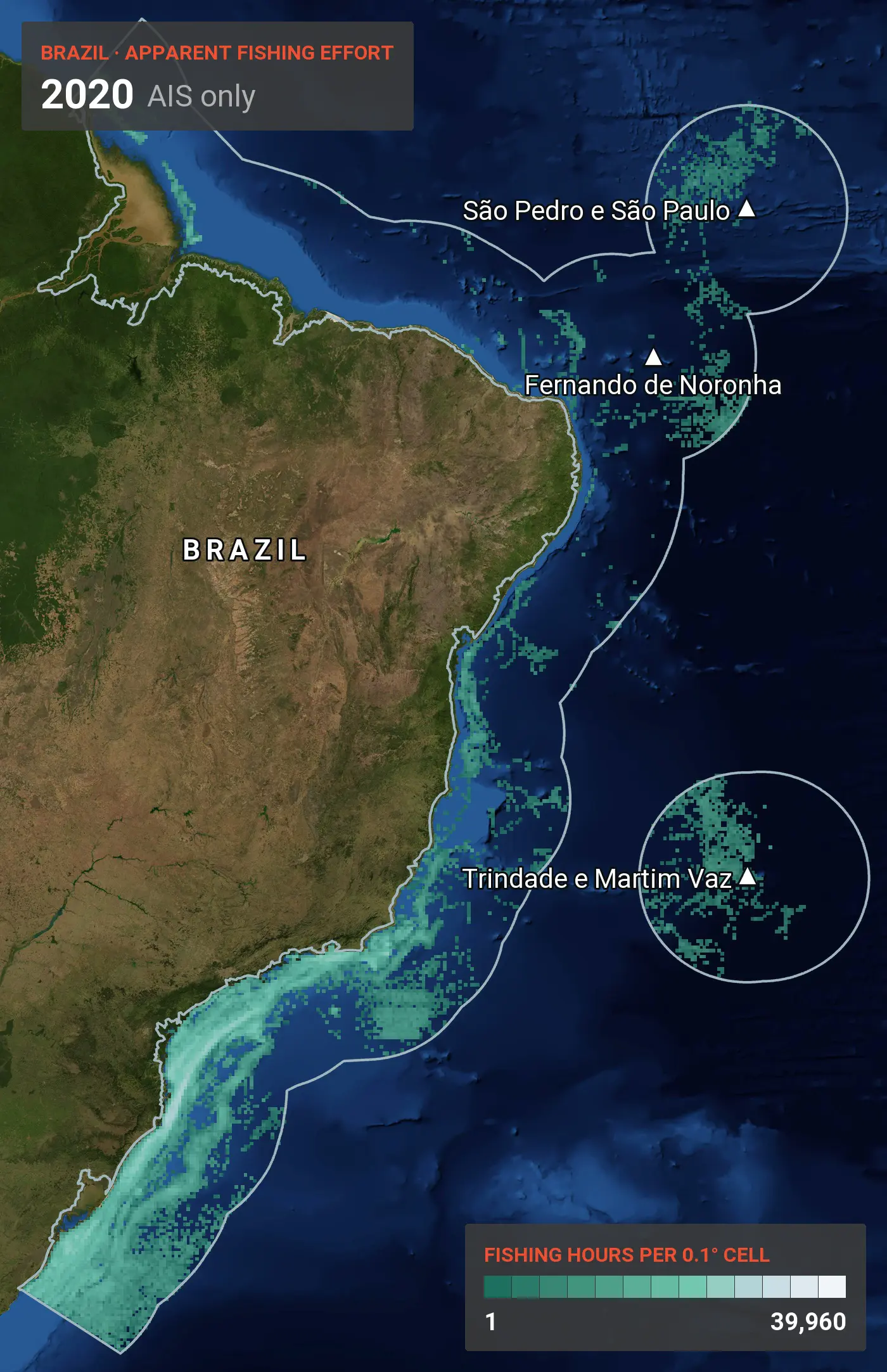
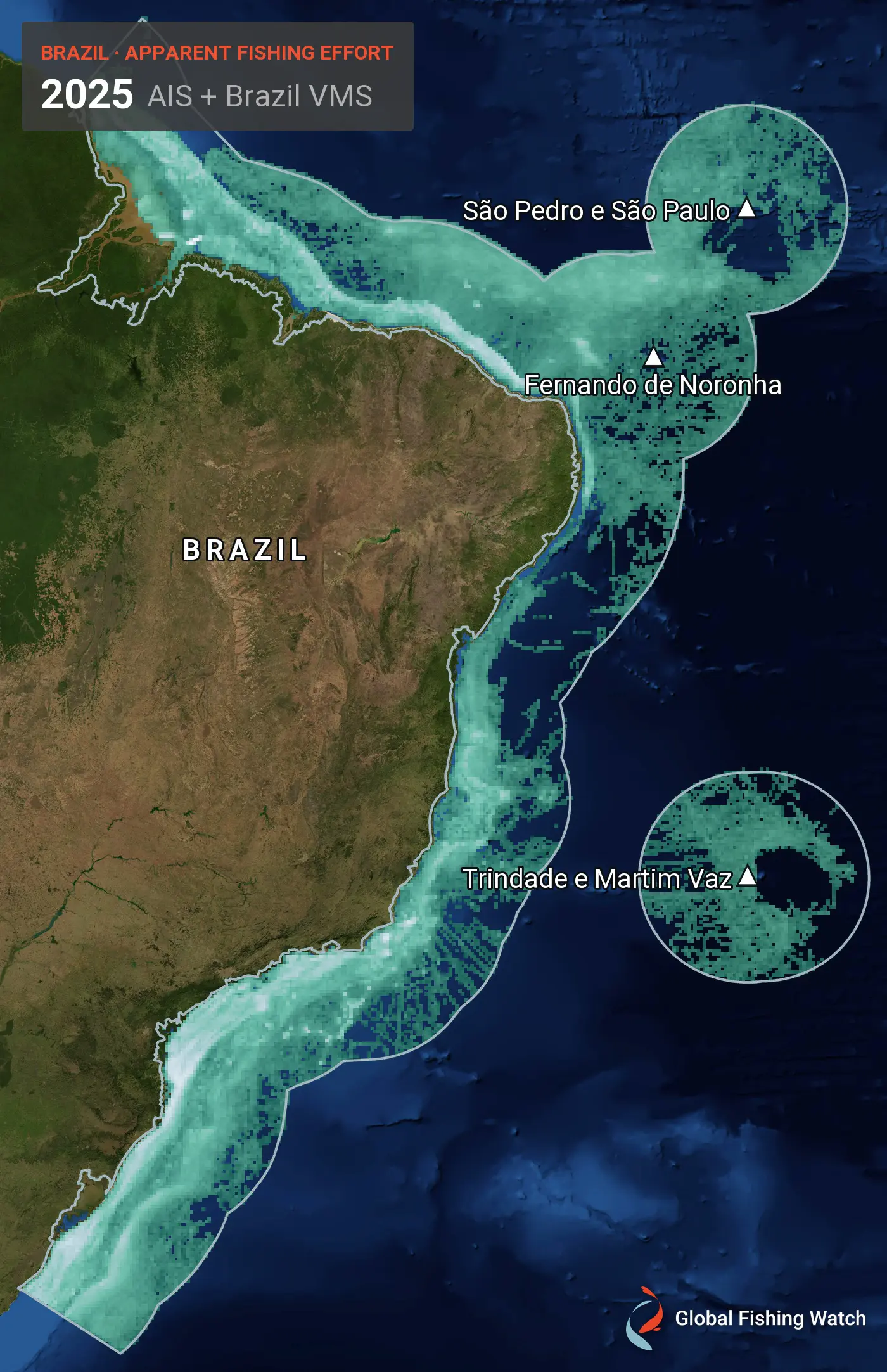

Apparent fishing activity in Brazil’s exclusive economic zones in 2020, from automatic identification system (AIS) data alone, and in 2025, with Brazil’s vessel monitoring data (VMS) added. The shared data accounts for about 89 percent of the additional fishing hours now visible. © Global Fishing Watch, 2026
According to Borcem, the publication of Brazil’s vessel data was merely the starting point of a fruitful partnership. With the aim of continuously improving transparency in management and enforcement, Brazil’s collaboration with Global Fishing Watch has since centered on strengthening the country’s satellite monitoring program for fishing vessels, known as PREPS.
Moreover, in recent years, Brazil has also concentrated its efforts on updating the country’s vessel monitoring system (VMS) and its regulations. Global Fishing Watch has supported Brazilian fisheries authorities by producing concrete recommendations aimed at updating national regulations and facilitating knowledge exchange through virtual workshops between seven Latin American countries and in-person visits to monitoring centers in Peru and Panama.
“Latin America is emerging as a leader in fisheries transparency and Brazil has shown how access to information can be translated into better decisions and stronger governance,” said Mónica Espinoza Miralles, Global Fishing Watch’s head of Latin America. “At Global Fishing Watch, we help connect countries so government officials can learn directly from their peers. We examine what worked, what didn’t and what it really takes to modernize a vessel monitoring system and advance regulatory reform.”
For Espinoza Miralles, Brazil’s regional leadership reflects a broader evolution in its partnership with Global Fishing Watch. What began as a transparency initiative has evolved into a long-term strategy to strengthen the legal, technical and institutional framework that underpins vessel tracking for monitoring, compliance and enforcement. Today, the partnership brings together Brazil’s fisheries, environmental and maritime authorities—including the Ministry of Fisheries and Aquaculture (MPA), the Ministry of Environment and Climate Change, the Brazilian Institute of the Environment and Renewable Natural Resources (IBAMA), the Chico Mendes Institute for Biodiversity Conservation (ICMBio) and the Brazilian Navy — to advance a more coordinated approach to ocean governance.
“Brazil’s experience shows that transparency is more than just a technological decision,” she continued. “True transparency requires sustained political will. Lasting change happens when countries strengthen the regulations, institutions and professional capacity needed to turn information into action.”
Turning data into enforcement
Transparency gains real value when paired with institutional action. And with the integration of Brazil’s General Fishing Registry (RGP) with the Global Fishing Watch platform, authorities can now connect vessel registration records with near-real-time tracking data, creating a more complete picture of fishing activity.
The result is a stronger foundation for planning inspections, identifying suspicious activity and supporting evidence-based fisheries management. New analytical tools for VMS data — including encounter detection, transmission-gap analysis and port-entry monitoring — give Brazilian authorities additional ways to prioritize inspections and understand activity at sea. These tools are currently available only on the private map.
But technology alone cannot improve ocean governance. Over the past five years, hundreds of Brazilian officials have participated in training programs supported by Global Fishing Watch, building skills in fisheries management, marine protected area monitoring and compliance. This investment in people and institutional capacity has turned Brazil into a regional model for neighboring countries seeking to strengthen their own vessel-tracking systems.
“The biggest change isn’t really visible on a screen. It’s in how authorities think about their day-to-day work,” said Luana Sêga, country officer for Brazil at Global Fishing Watch.
“Before, comparing a vessel’s registry with tracking data could take a long time; now, Brazilian authorities can verify within minutes whether a vessel was where it claimed to be, and that can completely change the way processes are carried out”, Sêga said.
The next horizon: 2026-2031

The renewed partnership between Brazil and Global Fishing Watch marks the next phase of the South American country’s effort to modernize ocean governance. Priorities include:
- Strengthening port controls: Supporting implementation of the Port State Measures Agreement to help prevent illegally caught seafood from entering Brazilian ports.
- Smarter protection for marine protected areas: Applying advanced analytics within marine protected areas to support conservation while recognizing legitimate fishing.
- Modernizing the national tracking program: Advancing regulatory updates to PREPS so vessel-tracking data can be used more effectively for monitoring, compliance and enforcement.
Data alone does not protect the ocean. What matters is how countries use that information to make better decisions, strengthen institutions and support the people responsible for managing marine resources. Five years after Brazil chose to make its fishing fleet more transparent, the partnership has evolved beyond open data into a long-term effort to modernize ocean governance. The renewed agreement through 2031 signals that this work is only entering its next chapter.