
Advancing Trust in Ocean Governance Starts With Responsible Data Practices
- By Paul Woods
- Published
Global Fishing Watch and Open Data Institute tackle ethical use of AI and open data – and how it can be applied to bolster ocean governance
At Global Fishing Watch, we gather vast amounts of data on human activity at sea, spanning large-scale industrial operations to individual artisanal fishing vessels. Using artificial intelligence, we extract insights from this data to create models that help us better understand what takes place beyond the horizon. Harnessing the power of our public map, we seek to create and publicly share knowledge about human activity at sea to enable fair and sustainable use of our ocean.
We have always been conscious that, when applying AI to vessel tracking data, there is a delicate balance between our power to make a positive impact and the potential to cause unintended harm to individuals, especially those that we strive to help. We’re also aware that inherent biases exist in the data we receive and our modeling processes can perpetuate or inadvertently introduce new bias.
As an open platform, our data can be used in unforeseen ways, which may result in unintended outcomes. For example, tracking vessels also means tracking people – which is one reason why, when we first started publishing vessel tracking data, we decided to delay public access to data until it is 72 hours old. As data becomes more powerful, the necessity of using it responsibly and ethically becomes ever more urgent.



Our approach to data ethics
Publishing reliable, trusted data is fundamental to who we are and what we do. Data ethics as a practice ensures that we consider both the positive and negative impacts of all our projects, mitigating potential harms while maximizing benefits.
Becoming an awardee of The Audacious Project in 2023 has allowed us to invest in institutionalizing data ethics within the organization. In 2024 we partnered with the Open Data Institute (ODI), leveraging their expertise to apply data ethics more systematically and consistently. In 2026, we will publish the first output from that work – our principles for data ethics.
In March 2025, the ODI conducted a data ethics maturity assessment, which suggested that, despite strong staff support and solid data practices to build on, the organization needed clear guidelines to move from ad hoc efforts to consistently applied processes.
We set a goal to establish data ethics standards across the organization, based on internal and external best practices. This involved identifying guiding principles and instituting knowledge building practices to develop a practical data ethics review framework and procedure for all data-related projects.
A framework to do good
We rolled out our data ethics principles internally in 2025. Having this clear set of guidelines enables our staff to take practical steps in each data project to ensure the outcome always aligns with our values. The principles also allow us to communicate more effectively about who we are, what we stand for, and what we intend to do — or not do — with data and AI.
Recently our international policy team started developing guidance around GPS tracking systems for our partners in different countries. They worked with our data ethics committee, an internal cross-team advisory board, to ensure the document was aligned with our data ethics principles, resulting in more transparent and cohesive guidance.
Building off this success, we developed a data ethics framework and a series of tools that our staff can consistently deploy to mitigate data ethics risks. This provides decision-makers, such as team and topic leads, with oversight of the challenges and unintended consequences associated with our projects. The framework also formalized a role for the data ethics committee, positioning members to serve as a review board in project workflows to ensure the right questions are being asked about the data. Given our global engagement, it’s important that our data ethics reviews include input from team members with diverse viewpoints, including those with regional, technical and subject matter expertise.
We have now trialed the framework in several projects, including an AI model for addressing forced labor and engaging with small-scale fisheries. It’s already streamlined project coordination, and resulted in clearer data communication and early planning of external community engagement.
While the work is still ongoing, our momentum is clearly building — and we are confident we will fully embed the framework processes across all data projects by the end of 2026. With a bit of diligence, discipline and adaptation, we hope to emerge as a data ethics thought leader for ocean governance, serving as a model for other organizations that collect and steward data for the collective good.
Data ethics in action: forced labor at sea
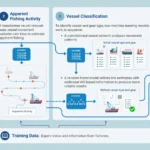
Forced labor, a form of modern slavery, is a serious problem in fisheries. Tens of thousands of fishers may be victims, but these abuses happen out of sight of authorities. To make this problem visible, we’ve trained a machine learning model using data from trusted sources to identify characteristics of vessels with a high risk of forced labor – including their movement patterns, gear type, number of voyages per year and total fishing hours on the high seas. By comparing these patterns to those of other publicly tracked vessels, the model can detect instances where the risk of forced labor may be high.
Our tool clearly has huge power to do good – an eye in the sky that could come to the aid of vulnerable fishers. However, the model is trained using data that has known biases and gaps — and we know a model can never be a fully accurate predictor of human rights abuses.
Our data scientist Laura Osborne, who undertook professional data ethics training with the ODI as part of our drive to increase internal data ethics capacity, identified key actions to enhance the positive impact of the project while mitigating risks. These included establishing clear guidelines for partners on how to interpret and use risk scores — for example, encouraging them to combine our tool with other sources of information rather than treat it as a single source of truth — clearly communicating the biases present in the training datasets. This helped highlight forms of forced labor that may be more difficult to identify, and implementing robust review mechanisms for our model.
From principles to practice
At the start of this journey, Global Fishing Watch was already an organization where many people genuinely cared about data ethics. But turning that commitment into structured, tangible action required dedicated leadership, targeted expertise and thoughtful support. Our focus is now shifting from intention to implementation, engaging everyone so that each team understands its role within the broader data ethics process.
Assessing data ethics isn’t just a box-checking exercise. Making the process truly work for our organization has required a highly tailored approach, one that is flexible enough to account for the evolving nature of data ethics. This has taken a significant investment of time and money, but it’s one we are confident will pay off in the long run as we continue to strengthen our reputation as a trusted source of data.
Paul Woods is chief innovation officer at Global Fishing Watch.