
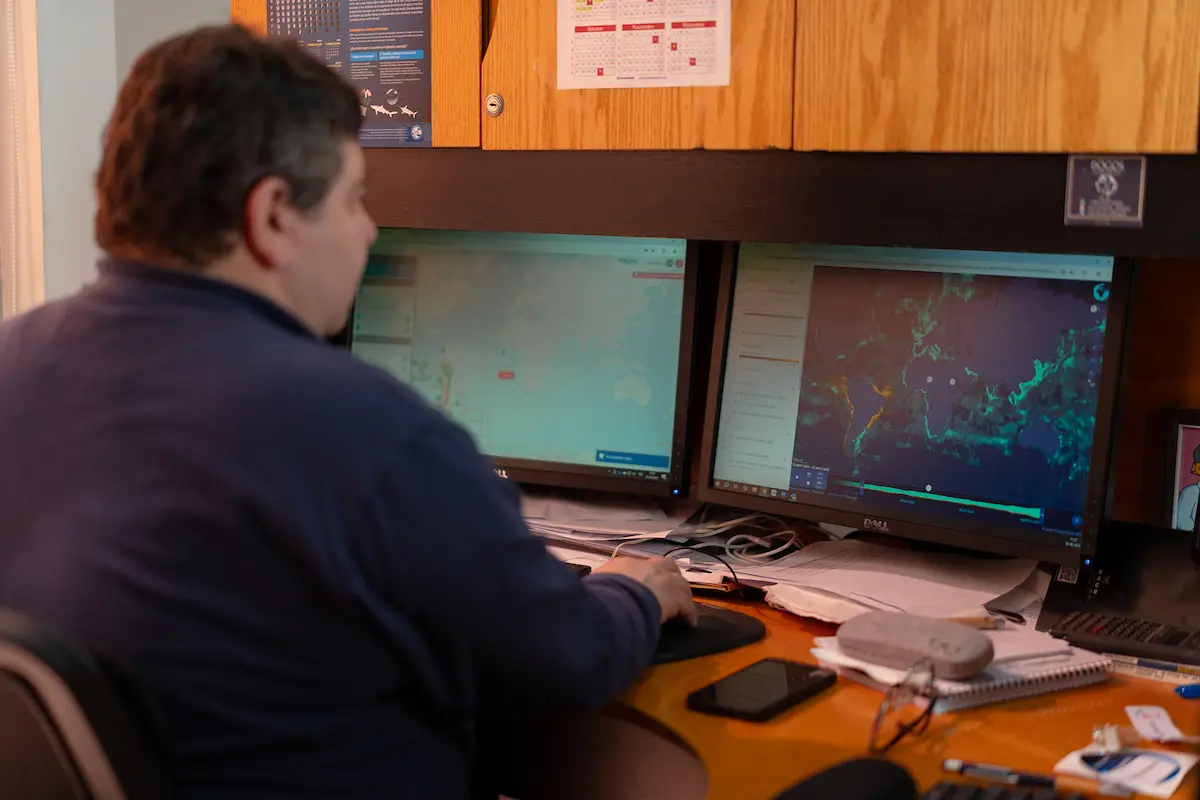
© Global Fishing Watch / Diego del Río
A practical new framework offers governments a cost-effective roadmap to improve vessel tracking systems, secure their waters and protect fisheries
Key takeaways
- Combining VMS and satellite AIS tracking linked by IMO numbers closes enforcement gaps and optimizes maritime monitoring cost-effectively.
- Decoupling high-frequency onboard VMS position logging from shoreward satellite transmissions captures brief fishing events without escalating data transmission costs.
- Aligning maritime legislation with provable digital behaviors like vessel speed inside closed zones simplifies prosecution and strengthens courtroom evidence.
Overview
The ocean is our planet’s greatest shared commons, yet as human pressure intensifies, much of the activity upon it remains dangerously opaque. As the ocean becomes ever more crowded and industrial pressures mount against a backdrop of overfishing and illegal activity, the need for a unified language around transparent vessel tracking has never been more urgent.
Although vessel tracking technology has been available since the mid-1990s, the monitoring of industrial fishing and support vessels is not governed by a single global standard, with public data-sharing policies varying widely by jurisdiction. The result is an uneven landscape of regulation that leaves vast areas of our ocean — and vessels — largely unmonitored.
Advanced tracking and data analytics have become rapidly indispensable across various sectors — particularly in the ocean — but they are not used equally. All governments should have practical, cost-effective tools to optimize their current systems and data, protect their waters, manage their fleets and detect illicit activity.
Downloads
Related Expert

Interim Co-Chief Policy and Program Officer

Director of Program Initiatives, Global Programs
Recent Content


A practical guide for vessel tracking
Governments increasingly rely on vessel tracking to manage fisheries, enforce regulations and strengthen maritime security. Yet many of these tracking systems remain fragmented, operate inefficiently and offer limited utility. “The Vessel Tracking Best Practices Guide” provides governments with a commercially neutral framework and practical recommendations to improve these systems and enhance transparency, interoperability and enforcement.
Developed by Global Fishing Watch, this resource draws on decades of global operational practices, expert contributions and the organization’s experience analyzing tracking data from over 150,000 vessels to create a comprehensive, practical roadmap for governments.
To reach their full potential, vessel tracking systems must be integrated, transparent and interoperable. By adopting these standards, States will be better positioned to protect marine resources, meet international obligations, attract responsible investment, strengthen maritime governance and deliver long-term benefits for the ocean and the people who depend on it.
While the “Vessel Tracking Best Practices Guide” is intended primarily for governments, it also serves as a key resource for fisheries practitioners. The guide aims to support decision-makers considering the adoption, improvement or expansion of vessel tracking systems.
Beyond these audiences, it is valuable to fisheries authorities, monitoring and enforcement agencies, coast guards, navies and legal drafters. It is also a vital tool for private sector and civil society partners, from seafood supply chain actors, service providers and the fishing industry to researchers, coastal communities and conservation groups.
Navigating the guide: A framework for best practices

The “Vessel Tracking Best Practices Guide” is built around a phased, technology-informed pathway to design, deploy and sustain robust vessel tracking systems. The guide navigates practitioners through the entire lifecycle of a system — from defining its core purpose, to understanding the technical architecture that makes data trustworthy, to establishing the financial and legal scaffolding that bolsters enforceability.
While vessel tracking systems can function operationally on their own, realizing their full value requires transparency — the publication of specific ocean and vessel data, as well as the policies that govern them. This ensures key stakeholders have access to vital information, allowing vessel tracking infrastructure to go beyond mere data collection and actively support management, governance decisions and regional cooperation.
The guide is structured into three comprehensive sections, moving from high-level strategic recommendations to granular execution.
Figure 1. Core Sections on Vessel Tracking

Foundations
Why we track, what we track and how transparency builds system integrity

Technical standards
Hardware, communications, data, interoperability and automated analytics

Costs and law
Funding models, legal drafting and the use of tracking data as courtroom evidence
Foundations of a vessel tracking system
The mandate for integrated tracking systems
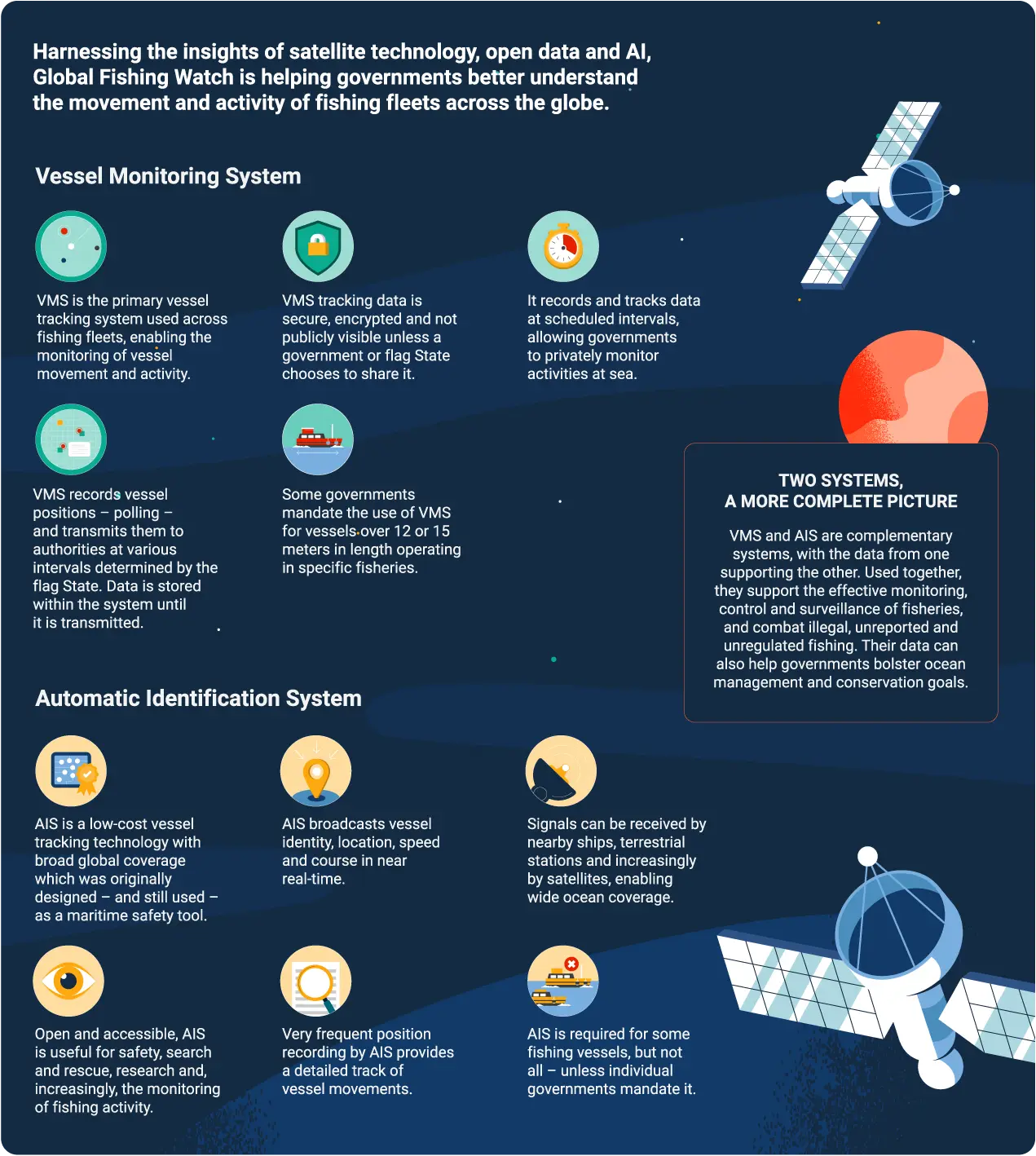
Relying on a single positional data source leaves a critical vulnerability in any fisheries or maritime security system. “The Vessel Tracking Best Practices Guide” offers a foundational recommendation: treat vessel monitoring systems (VMS) and automatic identification systems (AIS) as complementary tools, not competing ones. Used together and cross-referenced through a stable identifier — ideally the International Maritime Organization (IMO) number — these systems effectively close each other’s gaps and provide a more complete, reliable picture of vessel activity at sea.
Integration means authorities receive, store and analyze VMS and AIS data together, allowing analysts and automated systems to cross-validate vessel identity and position data, identify inconsistencies and strengthen compliance monitoring. Where one signal drops, the other can help determine whether a vessel kept moving in a pattern consistent with fishing, returned to port, entered a restricted area or simply turned off its transmitter.
Crucially, integrating the two systems does not double the costs. For countries that already operate VMS programs, adding an AIS data feed and linking it to existing monitoring systems is typically one of the most cost-effective ways to improve tracking coverage and data quality.
Because the effectiveness of integrated tracking depends on the quality and availability of both data sources, the guide also recommends strengthening national AIS requirements. Since most fishing vessels fall outside the IMO’s mandatory AIS carriage rules, requiring AIS for fishing fleets, to complement VMS tracking data, is a national decision — one that a growing number of countries have adopted. To help governments establish frameworks that ensure AIS complements VMS effectively, the guide recommends:
- National regulations align with IMO guidelines as a minimum.
- Requirements for AIS use and the device class match vessel size and operating conditions.
- Accurate identification information is broadcast using an authorized maritime mobile service identity — the identifier for the vessel's radio transmission — which must be properly linked to the vessel's permanent IMO number and vessel registry.
- AIS remains active at all times and is only deactivated on justified safety or security grounds, with strict reporting requirements.
- Designate unauthorized deactivation, misuse and falsification of data as prohibited acts — these activities ought to be monitored, investigated and sanctioned.
Figure 2. How Technology Is Used to Track Vessels
Transparency as a governance principle
Transparency and open data are gaining momentum in modern maritime governance. Because ocean resources are shared public assets, establishing open data as the baseline standard helps ensure equitable management and effective oversight.
To advance transparency from principle to practice, the guide sets out an eight-step pathway from public vessel identifiers and authorizations to published compliance records. By implementing this checklist, governments can systematically improve accountability, strengthen compliance and enable seamless regional cooperation that builds trust among governments, industry and civil society. Ultimately, States that embrace transparent approaches consistently report governance benefits that outweigh perceived risks.
Vessel tracking is no longer only a fisheries compliance tool to detect illegal, unreported and unregulated fishing; it now underpins:
- Maritime security efforts
- Marine spatial planning and protected-area management
- Search and rescue operations
- Labor and human rights monitoring
- Seafood traceability and market access
- Climate, biodiversity and conservation reporting
Key actions for decision-makers
Start with purpose, not procurement.
Define national monitoring, control and surveillance objectives and the specific compliance challenges that vessel tracking is intended to address before procuring any hardware.
Integrate by default.
Require VMS and AIS together for industrial fleets and support vessels, validating them against each other for a complete picture of activity.
Share data as standard practice.
Adopt the eight-step transparency pathway: public vessel IDs, authorizations, ownership, registers, tracking data, transshipment activity, compliance records and policies.
Govern the data, not just the device.
Apply the six data-ethics principles to every system decision: transparency, impact assessment, sustainability, responsible management, accessibility and inclusivity.
Invest for the long term.
Ensure sustainable financing and institutional coordination to maintain and continuously improve vessel tracking systems.
Align with regional and international obligations.
Bring national systems into alignment with regional fisheries management organization requirements and international instruments so States can satisfy their obligations and tracking data can be exchanged effectively across borders.
Technical standards and data processing
© Global Fishing Watch / Diego del Río
The “Vessel Tracking Best Practices Guide” follows tracking data from the device onboard, through the networks that carry it ashore, to the systems that store, secure and analyze it. Because there is no single global standard for VMS, a tracking system is only as good as the requirements each State sets. The guide therefore provides practical guidance on the choices to be made when designing or updating a system.
Frequency matters
Underpinning any tracking system is the polling rate — how often a vessel’s position is recorded — which ultimately determines what the system can detect. Short-lived events like fishing operations, transshipments and incursions into closed areas are only reliably captured when positions are recorded at intervals no longer than one-quarter of the event’s duration. Polling rates should therefore be matched to the events being monitored, rather than arbitrarily set at a standard one or two hours. AIS typically provides high-resolution data, transmitting every few seconds or minutes. VMS polling is set by national or regional regulations and polling every one to two hours has been standard for two decades, reducing key events to scattered points that are easily missed; that is why the guide calls for updating VMS regulations to require high-frequency polling of 1 to 15 minutes.
To achieve VMS polling rates that adequately support monitoring and enforcement while managing satellite communication costs, the guide recommends decoupling onboard data collection from transmission to shore. Devices record high-resolution positions in onboard storage and transmit them on a separate, risk-based schedule. This approach reduces transmission costs, improves scalability and makes high-quality vessel tracking more economically sustainable without compromising the integrity or usefulness of the data.
Vessel tracking architecture and standards
Governments should mandate certified, tamper-resistant onboard equipment linked to a stable, unique vessel identifier — the single most common limitation to vessel identity matching across databases in current tracking systems. Data must also be standardized using universal formats, such as ISO 8601 Coordinated Universal Time (UTC) timestamps and speed measured in knots.
Security must be treated as core infrastructure through encrypted transmissions, role-based access, audit logs and secure API exchanges between agencies. Because tactics like global navigation satellite systems spoofing and AIS identity manipulation are already widespread among fleets evading sanctions, cross-validation must be built into the system from day one rather than retrofitted later.
From foundational to advanced: Scaling your vessel tracking system
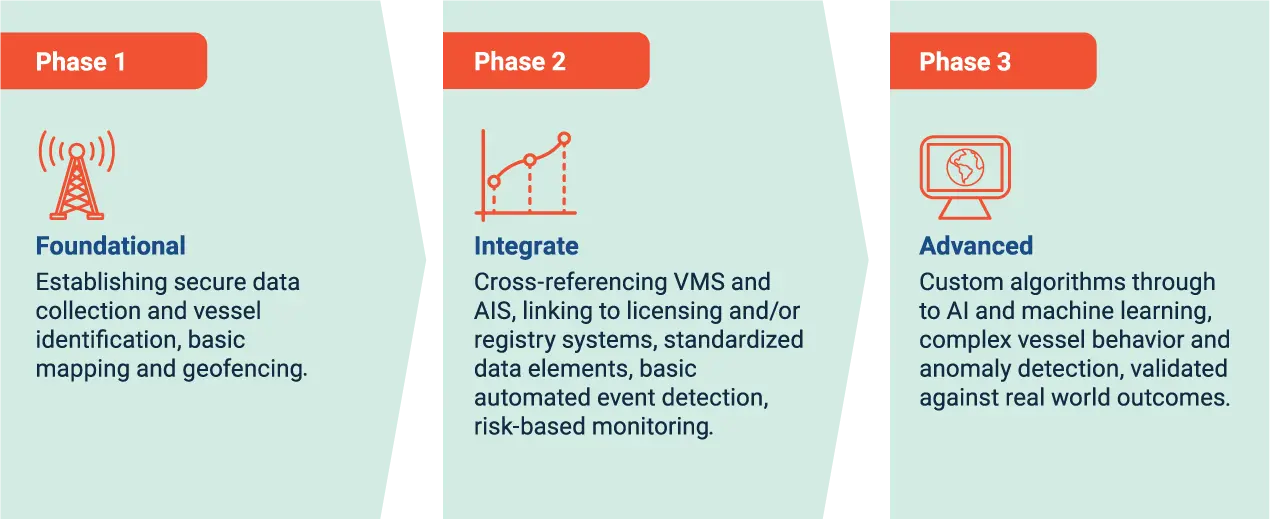
Vessel tracking capabilities are built over time, not overnight. A phased implementation strategy allows governments to secure operational wins in the short term while steadily laying the groundwork for more sophisticated, automated tracking down the road. By breaking system implementation into three manageable tiers, States can scale their investments and technical training in lockstep with their strategic needs.
States can build capacity in three stages, advancing at their own pace with foundational, integrated and advanced actions.
Figure 3: A Three-Phase Pathway to Reliable Vessel Tracking
Balancing automation with human intelligence
As maritime authorities increasingly rely on big data processing, artificial intelligence (AI) and machine learning to monitor exclusive economic zones, distinguishing between data-driven suspicion and actionable proof is critical. Automated alerts are designed to identify activities that warrant further attention — they do not provide definitive evidence of wrongdoing. Any response should be proportionate and focused on gathering additional information before enforcement action is taken.
While automated anomaly detection can efficiently flag suspicious behaviors across thousands of vessels, digital data has to be reliable, secure and trusted to meet the standard for legal prosecution or deployment of patrol and inspection assets. Therefore, automated detection must be continually ground-truthed by trained analysts against physical inspections, observer reports and electronic monitoring to confidently inform enforcement action. This verification loop cuts down on false alarms — which can overwhelm staff — and strengthens the evidentiary value of tracking data. The goal is not to automate everything, but to ensure the right information reaches the right people at the right time.
Key actions for decision-makers
Build resilience into VMS devices.
Require certified, tamper-evident hardware with at least 72 hours of backup power and 30 days of onboard storage.
Decouple VMS polling from transmission.
Record every 1–15 minutes, but transmit data packages on a separate, risk-based schedule.
Integrate AIS and regulate its use.
Build AIS into the system alongside VMS for wider coverage and cross-referencing, while requiring it for fishing vessels and regulating against misuse.
Fix the basics first.
Before pursuing advanced data exchange standards, first standardize vessel identifiers, UTC timestamps and speed units.
Secure the system that secures the data.
Embed encryption, role-based access and audit trails from day one.
Phase detection automation:
Systematically transition from manual review to geofencing, rules-based detection, and finally AI, validating each stage against real-world outcomes before scaling.
Costs and legal considerations
A tracking system’s success depends on more than technology. States must plan realistically for its full costs and align it with legal frameworks capable of turning tracking data into enforceable actions. The “Vessel Tracking Best Practices Guide” examines both dimensions — the underappreciated costs of running a vessel tracking system over time and the legal choices that determine whether tracking data holds up in court.
The true cost of vessel tracking
The true cost of vessel tracking lies far beyond the initial hardware and requires considering a cost allocation framework. Long-term success demands planning for frequently underestimated operational costs, such as staffing, training, monitoring center operations, automation infrastructure and ongoing AIS data access. It also entails determining which financial burdens fall on the government, the fishers or both.
Building adaptability into the certification and equipment approval processes can help avoid costly system overhauls, especially given the rapid evolution of technology and regulations. Decisions on how to manage the tracking systems are needed before the formal contracts with providers are signed. To navigate tradeoffs in a rapidly changing marketplace, governments should adopt a flexible approach to sourcing, choosing either a single provider or a diverse suite of providers, depending on what best aligns with their goals. Single provider systems limit competition and could raise costs, while managing many providers can create challenges around data consistency and quality.
Aligning laws and tracking systems for successful prosecution
Legal requirements should establish clear obligations or clearly prohibit specific activities and incorporate provisions that allow tracking data to be used as evidence. Where possible, legislation should be framed around behaviors that digital data can definitively prove, such as a vessel’s speed or physical presence inside a closed zone, rather than the much harder task of proving the active catching of fish. The range of sanctions should be listed.
To streamline judicial proceedings, legal frameworks should utilize rebuttable presumptions where permitted. This prevents prosecutors from having to re-establish the technology’s reliability in every individual case. To ensure tracking data is understood and valued in courtrooms where judges and prosecutors might be unfamiliar with the technology, expert witnesses who can explain the system mechanics and interpret the data in a way nonexperts can easily grasp are essential.
© Global Fishing Watch / Hanz Plenge
Examining international legal precedents reveals how tracking data has translated into actual courtroom outcomes. The guide presents real-world results from Argentina, Iceland, Panama, Papua New Guinea, Spain, the United States and the United Kingdom, demonstrating how vessel tracking data can successfully withstand legal scrutiny across diverse judicial systems. Crucially, the guide also includes a description of a case that failed, outlining lessons learned to help secure future convictions.
Key actions for decision-makers
Decide costs before announcing requirements.
Determine explicitly who pays — government, fisher or a shared model — across the full lifecycle of the tracking system, not just the cost of initial hardware.
Align legislation with data capabilities.
Draft prohibitions around provable behavior, such as speed-and-presence rules in closed areas.
Reduce the evidentiary burden.
Pursue a rebuttable presumption of VMS and AIS accuracy where the legal system permits it.
Design the system for the courtroom.
Prepare experts and visual exhibits tailored for judges and prosecutors.
Design the system with the end in mind.
Ensure sustainable staffing, continuous training and interagency data-sharing authority are established to make the law enforceable in practice.
The path forward
To succeed in the real world, vessel tracking must be treated as a comprehensive governance system rather than a standalone technology — it is an investment, not a cost.
Effective vessel tracking depends on robust legislation and dedicated resources and combining this data with transparency yields wide-ranging returns.
An international agreement on vessel tracking could deliver the standardization of practices and data that today’s patchwork of national systems lacks. Common standards would, in turn, facilitate data sharing, help States meet regional and international obligations and maximize the value of the data it already collects. Such a unified approach would enable governments to respond more effectively to suspected illegal activity and safeguard a broad range of critical ocean resources.
Improved vessel tracking depends on common standards, interoperable systems and transparent governance. The “Vessel Tracking Best Practices Guide” provides governments with practical recommendations to strengthen monitoring, support enforcement and improve fisheries governance. By adopting these standards, States can transform fragmented tracking into a seamless defense across jurisdictions that better supports sustainable ocean management.
For policymakers, legal drafters, technical leads and enforcement officers ready to turn intent into action, the full guide — complete with technical specifications, delivery mechanisms and legislative considerations — serves as the ultimate blueprint for implementation.